
Best Triathlon Wetsuits 2026: Multiplied Performance for Every Swim Split
The grind respects no excuses. Not the pre-dawn alarm, not the burning lungs, and certainly not equipment that fails to match your output. In your search for the best triathlon wetsuits, you know that sinking legs and shoulder fatigue are not mere frustrations; they are calculated deficits in a race won by seconds. Every ounce of drag from a poor fit or restrictive material is a tax on the power you have painstakingly built. Your commitment to performance demands a solution engineered with the same level of intensity.
This is your definitive breakdown for the 2026 season. We move beyond basic features to analyse the scientifically validated technology that will multiply your swim split. Here, you will discover the advanced materials and hydrodynamic architecture engineered to optimise buoyancy, maximise shoulder flexibility, and reduce your transition time to a seamless motion. This is your blueprint for selecting a second skin that transforms your hard-earned power into unparalleled speed. Human performance, multiplied.
Key Takeaways
- Understand how a precision-engineered wetsuit multiplies your training effort, transforming disciplined work into validated speed in the water.
- Analyse your unique swim profile-'sinker' or 'floater'-to determine the precise buoyancy architecture required for optimal hydrodynamic efficiency.
- Master the data-driven approach to selecting the best triathlon wetsuits, calculating the performance ROI of advanced Yamamoto neoprene for your experience level.
- Execute the 'Coach's Protocol' for achieving a race-ready fit, learning why a suit that feels restrictive on land is engineered for peak flexibility in the water.
Defining the 'Best': Why Your Triathlon Wetsuit is a Performance Multiplier
You have honoured the grind. The pre-dawn alarms, the punishing intervals, the thousands of metres logged in the pool. Your commitment to performance is absolute. A triathlon wetsuit is not an accessory; it is a precision-engineered tool designed to amplify that commitment. Its function is threefold: to deliver strategic buoyancy, provide critical thermal protection, and maximise hydrodynamic speed. To choose a mediocre suit is to compromise the very discipline you have spent months building. Mediocrity has no place on race day.
This highly specialised garment must not be confused with a surfing or diving suit. Those are built for warmth and durability. A triathlon wetsuit is an engineered system where every panel, seam, and coating is meticulously designed to reduce drag, enhance body position, and allow for an unrestricted freestyle stroke. The science behind advanced Triathlon equipment has evolved to meet the unique demands of the swim-bike-run, and the best triathlon wetsuits are at the apex of this evolution. The right suit multiplies your output, preserving core energy so you exit the water with more power for the bike and run ahead.
Buoyancy vs. Flexibility: The Great Balancing Act
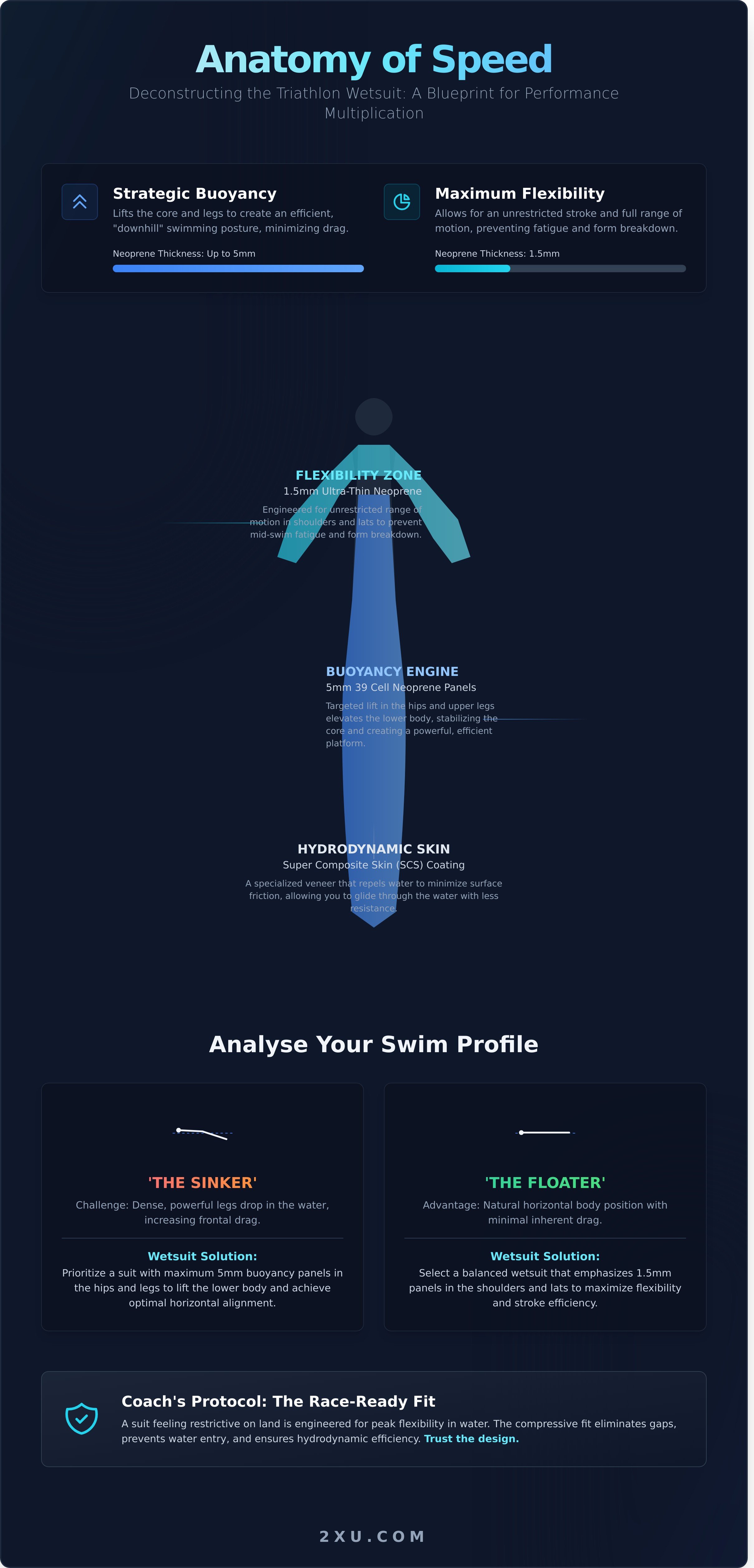
An elite wetsuit masters this fundamental trade-off through variable neoprene thickness. Panels up to the regulation 5mm are placed in the core and legs to elevate your body, correcting sinkage and promoting an efficient, downhill swimming posture. Conversely, the shoulders and lats utilise ultra-thin 1.5mm panels for unrestricted range of motion. This is non-negotiable. Shoulder restriction is a primary driver of mid-swim fatigue and a catastrophic breakdown in form, costing you precious minutes and energy.
Hydrodynamics and Surface Resistance
Performance is a game of marginal gains, and it begins at the surface. Advanced suits are treated with a Super Composite Skin (SCS) coating, a specialised veneer that repels water to minimise surface friction and allow you to glide through it. Some designs even incorporate engineered grooves or dimples to improve laminar flow, reducing turbulence. Hydrodynamic drag is the force of water resistance that directly opposes your forward motion, and minimising it is the key to faster swim splits.
The Science of Speed: Buoyancy Profiles and Hydrodynamic Efficiency
In the pursuit of peak performance, every watt of energy must be channelled into forward propulsion. The most significant barrier is not your competitor; it is drag. To conquer it, we must first analyse your unique physiology. Are you a ‘sinker’ with dense, powerful legs that drop in the water, or a natural ‘floater’? The answer dictates your wetsuit’s engineered buoyancy profile. The goal is not simply to float, but to achieve a perfectly horizontal, streamlined alignment that minimises your frontal area. This isn't theory; it's proven science. A peer-reviewed study on The Effects of a Wetsuit on Biomechanical, Physiological, and Perceptual Variables confirms that a correctly engineered wetsuit significantly reduces active drag, allowing for greater efficiency and speed. Understanding this science is critical when selecting the best triathlon wetsuits for your race day assault.
Targeted Buoyancy Panels: Lifting the Heavy Hitters
We engineer our suits with graduated buoyancy, meticulously placing panels where they deliver maximum lift without compromising technique. For athletes whose legs tend to sink, our proprietary 5mm 39 Cell front buoyancy panels in the hips and upper legs are non-negotiable. This targeted lift elevates the lower body, stabilising the core and creating a powerful, efficient platform. A stable core prevents ‘snaking’-the inefficient lateral movement that bleeds speed-allowing your energy to be converted directly into a higher, more effective stroke rate.
Flexible Underarm and Shoulder Zones
Maximum buoyancy is a liability if it restricts your power output. An unrestricted range of motion is paramount for an efficient catch and pull phase. This is why the quest for the best triathlon wetsuits focuses on optimising flexibility in critical zones. We utilise ultra-thin 1.5mm to 2mm neoprene through the shoulders and underarms. These engineered Intermediate Stretch Zone (ISZ) panels work with your anatomy, not against it, allowing for complete internal rotation and a natural reach. Every 2XU design is scientifically validated using precision testing equipment to assess and maximise range of motion, ensuring your mechanics are multiplied, not muted.
Selecting Your Armour: A Data-Driven Comparison of Wetsuit Tiers
Your wetsuit is not just equipment; it is a calculated investment in performance. The quest for the best triathlon wetsuits is a data-driven process, not a matter of opinion. Wetsuits are engineered across distinct tiers-Entry-Level, Intermediate, and Elite-each designed to multiply the performance of a specific athlete profile. The difference is grounded in physics and physiology, a fact validated by a comprehensive scientific review of wetsuit performance which proves the direct correlation between wetsuit construction and race-day efficiency. Investing in higher-grade Yamamoto neoprene delivers a measurable ROI through superior buoyancy and flexibility, but the ‘best’ suit is the one engineered for your battle.
For the elite, marginal gains are everything. For the novice, survival and efficiency are the mission. Understand the tiers to choose your armour wisely.
Entry-Level Suits: Stability and Confidence
For the athlete new to the grind of open water, the priority is absolute stability. These suits are engineered with maximum buoyancy, often utilising thicker neoprene panels around the core and legs to elevate your body position. This correction in form reduces drag and conserves critical energy. A more durable outer skin withstands the rigours of training and race-day transitions, building the confidence required to remain calm and efficient when the pressure is on.
Elite-Level Suits: Precision and Power Output
At the elite level, the suit becomes an extension of the athlete, engineered to maximise power output. Proprietary technology like Muscle Containment Stamping (MCS) provides targeted compression to reduce muscle oscillation and fatigue. Internally, 520% stretch linings allow for an unrestricted range of motion, enabling explosive movements. On the exterior, forearm water-gripping panels are engineered to increase the surface area during the catch phase of your stroke, translating every ounce of effort into forward propulsion.
Ultimately, durability is a factor of design intent. High-performance materials offer unparalleled flexibility but demand meticulous care. Cheaper alternatives provide robustness. The best triathlon wetsuits are not defined by price, but by their precise alignment with your ambition and discipline.
Respecting the Grind: Precision Fit, Maintenance, and Transition Mastery
Your wetsuit is a piece of high-performance equipment, engineered for one purpose: to multiply your power in the water. Mediocrity has no place here. The best triathlon wetsuits are not merely worn; they are weaponised. Respecting this tool means mastering its application with the discipline of an elite athlete, from the pre-race fit to post-race care. This is the grind that separates the prepared from the hopeful.
A compression fit on land is not a flaw; it is a design feature. A suit that feels loose on land will scoop water, increase drag, and negate your power output. Trust the engineering. Execute the fit protocol with precision to unlock its true potential.
The 5-Step Fit Protocol
- Protect the Investment: Always use gloves. The cardinal sin of any serious triathlete is a fingernail tear through high-performance neoprene. This is non-negotiable.
- Eliminate Restriction: Work the material up the legs methodically, ensuring the suit is pulled high into the crotch. Failure here is the primary cause of shoulder restriction and wasted energy.
- Seal the System: The neck seal must be flush against the skin. It should feel secure without impeding breathing, preventing water entry that compromises hydrodynamics.
- Verify Mobility: Perform the 'arm-swing' test. Execute full, powerful arm circles. You should feel compression and support, not painful restriction. This confirms the suit is correctly positioned on your torso.
- Complete the Seal & Breathe: Once the suit is on and mobility verified, zip it up fully. Take a few deep breaths. The suit should feel like a second skin, snug but not restrictive to your breathing. This final check ensures readiness for peak performance in the water.
T1 Mastery: The Rapid Exit Technique
The objection that a wetsuit costs time in T1 is a failure of preparation, not equipment. Elite performance demands elite execution. Shave critical seconds off your transition with disciplined practise, transforming a potential liability into a seamless, fluid motion. Master these techniques:
- Minimise Friction: Apply a body lubricant to your wrists and ankles pre-race. This allows the suit's cuffs to slide off instantly, eliminating struggle.
- Execute the 'Peel and Step': As you run from the water, pull the suit down to your waist. Once at your bike, use one powerful, deliberate motion to peel the suit down one leg and step on it with the opposite foot to pull it free. Repeat. Do not sit down.
- Rehearse for Race Day: 'Dry runs' are mandatory. Practise builds the muscle memory required for an automatic, sub-10-second exit under race-day pressure.
The grind doesn't end when you cross the finish line. Your gear has performed; now you must recover it. Rinse your suit with fresh water immediately. Hang it to dry inside-out, away from direct sunlight. Proper care is not a chore; it is a fundamental part of the performance lifecycle, ensuring your equipment is ready to perform for seasons to come.
Just as you preserve your equipment, it's worth preserving the memories of the hard-earned victories and personal bests. To commemorate your journey from the grind of training to the glory of the finish line, you can explore Layflat Photobooks to create a lasting tribute to your achievement.
Engineered for the Elite: The 2XU Propel Series Advantage
Mediocrity is a choice. The 2XU Propel series is engineered for the athlete who refuses to make it, embodying our core philosophy: Human Performance. Multiplied. This is not about marginal gains; it is about a fundamental shift in what you can achieve in the water. We built this advantage using proprietary technology, including Muscle Containment Stamping (MCS) for targeted compression, powerful PWX fabrication for unparalleled support, and industry-leading Yamamoto 45 Cell neoprene for maximum buoyancy and flexibility.
These are not empty claims. Our commitment to quantifiable results is absolute. Every one of our best triathlon wetsuits is meticulously assessed using the Salzmann pressure measurement device, a medical-grade tool that validates the precise graduated pressure profile required for enhanced performance and reduced fatigue. The result is a scientifically proven hydrodynamic advantage that allows you to exit the water faster, with more energy for the bike and run.
Propel P:1 vs. Propel P:2 vs. Propel Pro
Your race goals demand specific tools. Select the engineered advantage that matches your ambition:
- Propel Pro: Engineered for the sub-60 minute Ironman swimmer. Its defining feature is ultimate flexibility through the shoulders and arms, utilising 45 Cell neoprene for an unrestricted stroke that translates power directly into speed.
- Propel P:2: The versatile weapon. It strikes a calculated balance between the elite flexibility of the Pro and the powerful buoyancy of the P:1, making it a formidable tool for competitive age-groupers.
- Propel P:1: The gold standard. For the athlete demanding reliable, high-performance buoyancy to maintain an optimal body position and conserve energy, the P:1 delivers unwavering performance, race after race.
Join the Elite: Multiplied Results Start Here
You have done the work. You have respected the grind. Now, respect your effort by equipping yourself with gear that is as committed to performance as you are. The search for the best triathlon wetsuits is over. The technology is ready. The only remaining question is: are you?
Stop compromising on your swim split. Your next personal best awaits.
Explore the 2XU Triathlon Collection and Get Race Ready.
Your Performance, Multiplied: The Final Verdict
The search for the best triathlon wetsuits ends not with a simple purchase, but with an understanding of performance science. We've established that optimal buoyancy profiles, advanced hydrodynamic efficiency, and a precision fit are the non-negotiable pillars of a faster swim split. This is about selecting an engineered tool, not just a piece of gear.
The grind you endure in training deserves equipment engineered to honour that commitment. Trusted by elite IRONMAN champions, the 2XU Propel Series is the culmination of this philosophy. It leverages scientifically proven Yamamoto neoprene for unparalleled flexibility and our proprietary Muscle Containment Stamping (MCS) technology to reduce muscle oscillation and amplify power. This is the calculated advantage you've earned. Shop the 2XU Propel Wetsuit Series - Human Performance. Multiplied.
You've respected the grind. You've earned your place on the start line. Now, equip yourself with the armour to dominate it. Go multiply your potential.
Frequently Asked Questions
How should a triathlon wetsuit fit for optimal performance?
The fit of the best triathlon wetsuits is engineered to be a second, hydrodynamic skin. It must be compressive but not restrictive, allowing full range of motion through the shoulders for an uninhibited stroke. There should be no significant air gaps around the lower back or underarms. The neck seal must be flush to prevent water entry, which increases drag and weight, without impeding your breathing. An optimal fit is the foundation of peak performance.
Can I use a surfing wetsuit for a triathlon?
Negative. A surfing wetsuit is engineered for thermal insulation and durability against abrasion, not hydrodynamic speed. Its construction restricts shoulder mobility, fundamentally compromising your stroke efficiency and increasing fatigue. Triathlon wetsuits utilise advanced neoprene with variable thickness panels to optimise buoyancy and flexibility. Using a surf suit for a triathlon actively works against your performance goals and is an unacceptable compromise for any serious athlete.
What is the difference between Yamamoto 38, 39, and 45 cell neoprene?
Yamamoto neoprene is graded by its cellular density and flexibility. Yamamoto 38 is a durable, highly buoyant material often used in core body panels. Yamamoto 39 offers a significant increase in flexibility and is considered the benchmark for high-performance suits. Yamamoto 45 represents the apex of neoprene technology, providing unparalleled stretch and buoyancy. The highest-grade materials are strategically panelled in areas requiring maximum mobility, like the shoulders and lats, to multiply your power output.
How do I prevent chafing while wearing a triathlon wetsuit?
Chafing is a failure of preparation. The primary defence is a correctly fitted wetsuit, which minimises movement against the skin. For high-friction zones-specifically the neck, underarms, and crotch-apply a specialised anti-chafe balm or body lubricant before you suit up. This creates a protective barrier that reduces friction over the duration of the swim. Do not neglect this step; discipline in your pre-race routine prevents performance-inhibiting discomfort on race day.
Are triathlon wetsuits legal in all IRONMAN races?
Wetsuit legality in IRONMAN events is dictated by a non-negotiable factor: water temperature. For age-group athletes, wetsuits are generally permitted in water temperatures up to and including 24.5°C (76.1°F). They become mandatory below 16°C (60.8°F). Any temperature above 24.5°C renders wetsuits illegal to maintain fair competition. It is your responsibility as an athlete to consult the official race-day briefing for the final ruling. Plan for all contingencies.
How much time can a high-quality wetsuit save me over 1500m?
The time advantage is scientifically proven and significant. Depending on an athlete's baseline swimming proficiency, a high-performance wetsuit can reduce swim times by 5-10 seconds per 100 metres. Over a 1500m distance, this translates to a quantifiable saving of 1 to 2.5 minutes. This advantage is derived from optimised buoyancy, which elevates the lower body to create a more streamlined profile, and a hydrodynamic coating that minimises friction. This is not just about speed; it's about energy conservation.
What is the best way to clean and store my wetsuit after a race?
Your equipment is an investment in your performance; treat it with discipline. Immediately after use, rinse your wetsuit thoroughly inside and out with fresh, cold water to remove salt, chlorine, and organic matter. Never use detergents or hot water, as they degrade the neoprene and its bonded seams. Hang it to dry inside-out on a broad-shouldered hanger, away from direct sunlight. Once the interior is dry, reverse it. Proper care is non-negotiable for equipment longevity.