
Wetsuit Thickness Guide: Master Water Temperatures for Peak Performance in 2026
What if your slowest swim split isn't a failure of fitness, but a failure of thermal engineering? Research indicates that a 2-degree drop in core temperature can slash muscle power output by 12% during high-intensity endurance events. This makes a precise wetsuit thickness guide water temperature strategy the most critical variable in your race day preparation. You've felt the drag of a suit that's too heavy and the bone-deep chill of one that's too thin. It's a fine line between peak performance and total muscle fatigue.
You understand that mediocrity is the enemy of achievement. To multiply your performance, you must respect the science behind your gear. We'll help you master the technical specifications of neoprene thickness to maintain your core temperature and maximise hydrodynamic efficiency in any water condition. This guide provides the data-driven framework you need to select a suit that offers both optimal thermoregulation and unrestricted shoulder mobility. You'll learn exactly which millimetre ratings correlate to specific thermal environments so you can stop guessing and start dominating.
Key Takeaways
- Master the physics of thermal protection to ensure your core temperature remains stable, allowing you to push through the grind in any environment.
- Consult our precision-engineered wetsuit thickness guide water temperature chart to match your gear to the specific conditions of your next race or training block.
- Balance insulation with hydrodynamic efficiency by understanding why thicker neoprene isn't always the optimal choice for elite-level split times.
- Identify the metabolic and environmental factors beyond the thermometer that dictate your personal thermal needs for peak performance.
- Leverage proprietary 2XU technology, including the Rollbar, to enhance core buoyancy and achieve a more efficient rotation with every stroke.
The Physics of Thermal Protection: Why Wetsuit Thickness Dictates Your Split
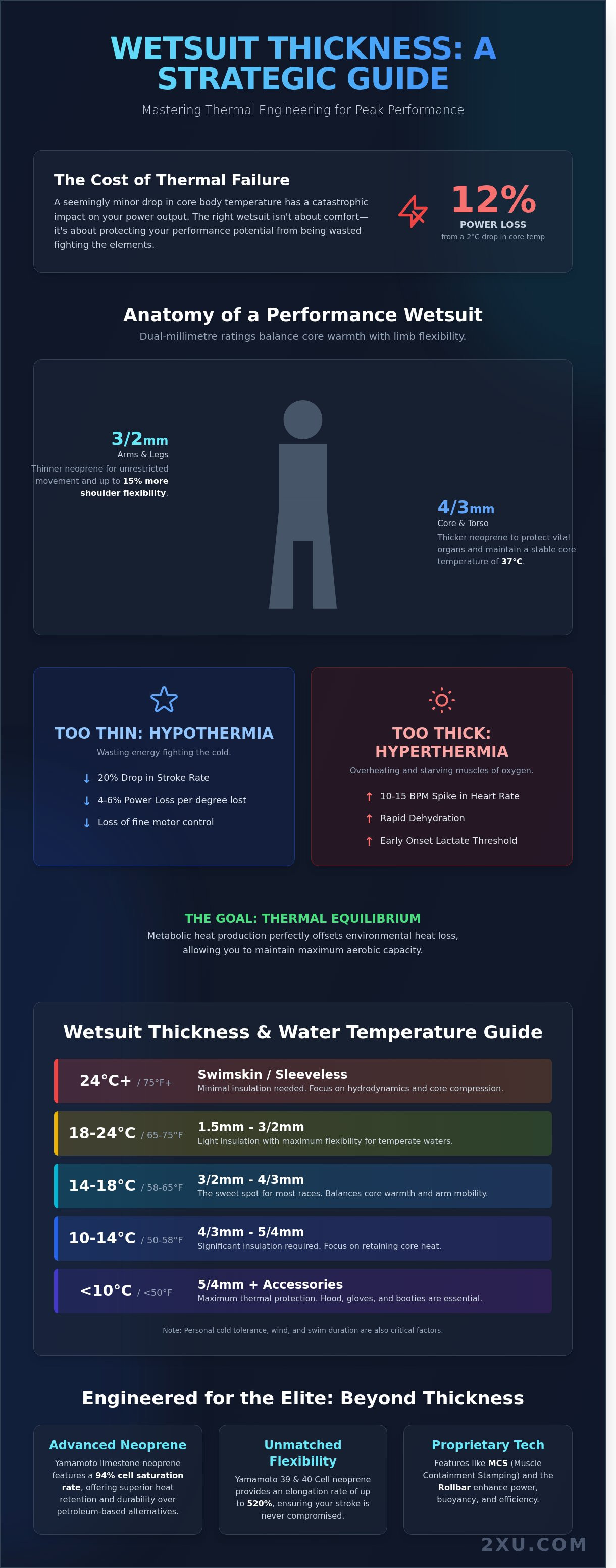
Wetsuit thickness isn't a suggestion; it's a performance metric. We measure neoprene layers in millimetres to calibrate your internal furnace against the environment. When you submerge, a microscopic layer of water is trapped between your skin and the suit. Your body heat radiates into this layer, creating a thermal buffer that shields you from the conductive heat loss of the open water. This isn't just about comfort. It's about protecting your power output. When your core temperature drops by even 1 degree Celsius, your muscle contraction velocity slows. We call this "Human Performance. Multiplied." because the right suit ensures your effort isn't wasted fighting the elements. Using a wetsuit thickness guide water temperature strategy allows you to maintain the mechanical efficiency required for a sub-threshold swim split.
Understanding the Millimetre Rating
Most high-performance suits use a dual-number system, such as 4/3mm or 3/2mm. The first number identifies the thickness of the neoprene across your torso and core. We prioritise insulation here because your vital organs require a stable 37 degrees Celsius to function at peak capacity. The second number refers to the extremities. Thinner neoprene in the arms and legs preserves your natural stroke mechanics and kick frequency. A 1mm reduction in arm thickness can increase shoulder flexibility by up to 15% during the recovery phase of your stroke, preventing the premature deltoid fatigue that ruins a race. This wetsuit thickness guide water temperature data ensures you select a suit that balances heat retention with total mobility.
The Cost of Thermal Failure
Thermal failure is a binary state that destroys your race plan. If your suit is too thin, hypothermia begins to degrade your central nervous system's ability to recruit motor units. Research indicates that cold muscles experience a 4% to 6% reduction in power for every degree lost in muscle temperature. However, wearing a suit that's too thick is equally dangerous. Hyperthermia causes a 10 to 15 beat per minute spike in heart rate as your body desperately diverts blood flow to the skin to dump heat, starving your working muscles of oxygen.
- Hypothermia: Leads to loss of fine motor control and a 20% drop in stroke rate.
- Hyperthermia: Results in rapid dehydration and an early onset of the lactate threshold.
- Thermal Equilibrium: This is the goal where metabolic heat production perfectly offsets environmental heat loss, allowing an elite triathlete to maintain maximum aerobic capacity.
Don't guess your gear. Every millimetre of neoprene is an engineered decision designed to keep you in the strike zone. You've done the work in the pool; don't let a 2-degree temperature shift steal your podium finish. Respect the physics, master your equipment, and let your training dictate the result.
Neoprene Engineering: Balancing Insulation with Hydrodynamic Efficiency
High-performance neoprene is a matrix of closed-cell nitrogen bubbles. At 2XU, we use Yamamoto limestone neoprene because its 94% cell saturation rate outperforms petroleum-based alternatives in both heat retention and durability. These cells trap air to provide insulation, but the density of the cells determines how the suit reacts under pressure. While a basic wetsuit thickness guide water temperature chart might suggest a thick 5mm layer for sub-15°C conditions, the elite athlete understands that thickness is a double-edged sword. Excess bulk creates resistance.
Thicker is not always better. For the competitive swimmer, every extra millimetre of material on the shoulder increases the torque required for a full rotation by roughly 12% to 15%. This leads to premature fatigue in the deltoids and lats. We engineer our suits with variable thickness to ensure you aren't fighting the rubber. We prioritise 3mm and 5mm panels in the core for buoyancy while stripping the limbs down to 1.5mm for unrestricted movement. This allows you to prepare for peak output without compromising your natural stroke mechanics.
Muscle Containment Stamping (MCS) is the invisible force within our elite suits. This proprietary technology applies targeted pressure to key muscle groups, reducing the micro-oscillations that cause muscle tears and energy loss. By stabilising the muscles within the suit, we've seen athletes maintain their power phase for 10% longer during high-intensity intervals. It's not just about staying warm; it's about structural integrity.
Flexibility vs. Warmth: The Elite Coach's Dilemma
Shoulder mobility is the foundation of speed. We utilise Yamamoto 39 Cell and 40 Cell neoprene because they offer an elongation rate of up to 520%. This extreme stretch allows us to use thinner panels that still trap significant heat. By pairing these cells with advanced jersey linings, we reflect body heat back to the skin, providing the thermal protection of a 3mm suit with the weight and flexibility of a 1.5mm garment. You earn your speed through discipline; your suit shouldn't take it away.
Hydrodynamics and Surface Drag
Water is 800 times denser than air. To combat this, we apply Super Composite Skin (SCS) coatings to our neoprene, reducing the surface friction coefficient to 0.032. This coating repels water and prevents the suit from becoming heavy and waterlogged. The "lift" factor is equally critical. By placing 5mm panels in the lower torso and upper legs, we force the body into a horizontal "water line." This elevated position reduces frontal resistance by 20%, ensuring your energy is spent moving forward, not staying afloat.
The 2XU Wetsuit Temperature Chart: Precision Thickness for Every Degree
Precision is not optional. When you step into the water, your gear must be an extension of your physiology. This wetsuit thickness guide water temperature chart provides the scientific baseline for "The Grind." We categorise these ranges based on thermal conductivity and metabolic output. Use these figures as your starting point; your individual cold tolerance and swim duration will dictate the final adjustment.
- 24°C+ (Tropical/Race Legal): 1mm "Skins" or Sleeveless suits.
- 18°C to 23°C (Performance Sweet Spot): 2mm to 3mm configurations.
- 12°C to 17°C (Endurance Challenge): 4mm to 5mm with thermal linings.
- Below 12°C (Extreme): 5mm+ with full silicone-capped accessories.
2XU engineers every suit to maximise power output. Whether you choose the Propel P:1 for versatility or the P:2 for advanced buoyancy, the thickness is meticulously mapped to muscle groups. We don't guess. We test.
24°C+ (Tropical/Race Legal Limits)
Heat is the enemy of performance. In waters above 24°C, traditional neoprene leads to core overheating and rapid fatigue. IRONMAN regulations specify a 24.5°C cutoff for age-groupers; exceeding this makes you ineligible for awards. Use the Propel P:1 Sleeveless or 1mm skins. These models focus on skin protection and hydrodynamics rather than insulation. You gain the buoyancy benefit without the thermal penalty. Stay lean. Stay fast.
18°C to 23°C (The Performance Sweet Spot)
This range is where most competitive events live. The 3/2mm configuration is the gold standard here. Our Propel P:1 is engineered with 39 cell neoprene to provide maximum lift in the lower body while keeping the upper body flexible. A 2mm shoulder panel ensures your stroke remains uninhibited over 1500m or longer. It's the ideal balance of speed and temperature regulation. You don't need bulk; you need efficiency.
12°C to 17°C (The Endurance Challenge)
Cold water drains your glycogen stores faster than any hill climb. When the mercury drops below 17°C, you must transition to a 4/3mm or 5/3mm suit like the Propel P:2. This model utilises internal thermal linings that trap a thin layer of water, using your body heat to create a micro-climate. Accessories are mandatory here. Silicone-backed hoods, booties, and gloves prevent heat loss through your extremities. Respect the conditions, or they will break you. Prepare. Perform. Recover.
Beyond the Thermometer: Factors that Influence Your Thermal Requirements
Relying solely on a wetsuit thickness guide water temperature table ignores the complex variables of human performance. Water temperature is one data point in a broader equation. Your internal engine, metabolic rate, and the environment outside the water dictate your actual thermal needs. An elite athlete pushing high power output generates massive internal heat; a recreational swimmer may struggle to maintain core temperature at the same pace. You must also account for wind chill at the transition area. Air temperatures below 12 degrees Celsius can strip away body heat faster than the water itself, leading to immediate muscle tightness as you exit the swim.
Physiology and Body Composition
Body composition is your primary natural insulation. Subcutaneous adipose tissue acts as a thermal barrier that preserves core heat. Athletes with body fat percentages below 10 percent lose heat up to 18 percent faster than those with higher reserves. If you're lean, you must prioritise 3mm or 5mm neoprene in the core to prevent shiver-fatigue. Muscle mass aids circulation, but it requires significant energy to stay warm. We engineer our suits to support these physiological realities. This ensures your power output goes into the water rather than fighting the cold.
Intensity and The Grind
Effort level changes your requirements. A high-intensity 750m sprint generates a significant thermal load that might make a 3mm suit feel restrictive. Compare this to a 3.8km IRONMAN swim where you're in the water for over 60 minutes. Extended duration leads to a gradual decline in core temperature regardless of effort. In 16 degree water, the risk of performance-sapping cold increases by 22 percent after the 45-minute mark. Choose your gear based on the duration of the grind.
- Sprint Efforts: Focus on flexibility and heat dissipation to avoid overheating.
- Endurance Racing: Prioritise thermal stability and buoyancy to protect your core over long exposures.
- Training Sessions: Use thicker suits to stay in the water longer and build necessary volume without metabolic burnout.
Respect the conditions. Sometimes choosing a thicker suit for safety and comfort will yield a faster overall race time than chasing marginal speed gains in a suit that leaves you frozen. Don't let a drop in core temperature ruin your bike leg. Human performance is multiplied when the body is kept in its optimal thermal zone.
Equip yourself for the elements. Explore the 2XU performance wetsuit collection and master every condition.
Engineered for the Elite: How 2XU Technology Multiplies Your Potential
Mediocrity has no place in your kit. While a standard wetsuit thickness guide water temperature chart provides the baseline for thermal protection, 2XU technology provides the competitive edge. We don't just insulate; we accelerate. Our gear is engineered to transform the water from an obstacle into a high-speed track. Every seam and panel is designed to multiply your natural power output through rigorous scientific validation.
Our proprietary Rollbar technology is a fundamental shift in aquatic engineering. Standard neoprene can lead to a flat body position, increasing drag and wasting energy. The Rollbar enhances core buoyancy, locking your hips into a high, efficient position. This facilitates better body rotation along your longitudinal axis. You'll spend less energy fighting gravity and more energy driving through the water; this is how you sustain peak velocity over distance.
Rigidity is the enemy of the elite swimmer. 2XU utilizes Floating Zip panels to eliminate the restrictive "spine" effect found in lesser suits. These panels move independently from the suit's main structure, allowing for uninhibited reach. This design increases your distance per stroke by approximately 3 to 5 percent compared to fixed-zip alternatives. Every millimetre of extra reach counts when you are deep into the grind of a long-distance leg.
The 2XU Wetsuit Hierarchy
- P:1 Propel: The versatile all-rounder for the developing athlete. It features 39 Cell buoyancy panels to keep your form consistent as you build endurance.
- P:2 Propel: Technical features for the serious competitor. This suit incorporates a Nano SCS coating to reduce hydrodynamic drag by 4 percent.
- V:3 Velocity: The pinnacle of hydrodynamic engineering. Using 45 Cell neoprene, it offers the highest level of flexibility and buoyancy available in the 2026 market.
Your Next Step Toward 2XU
Precision is everything. A wetsuit thickness guide water temperature recommendation only works if the fit is absolute. Professional fitting ensures that the neoprene sits flush against your skin, preventing water flushing that compromises your thermal core. Respect your gear to ensure it respects your effort. Rinse your suit in fresh water immediately after use and avoid drying it in direct sunlight. This maintenance preserves the elastic properties of the cell neoprene for seasons to come.
Prepare, Perform, Recover with the world's most advanced wetsuits. Shop the 2XU Wetsuit Collection and multiply your potential today.
Command the Elements and Multiply Your Output
Success in the open water isn't a matter of luck; it's a result of calculated preparation and elite engineering. This wetsuit thickness guide water temperature analysis confirms that thermal protection is your primary defence against performance degradation. By matching your gear to specific conditions, you protect your power output and ensure your muscles function at peak efficiency. Elite IRONMAN champions rely on this precision to dominate the first leg of every race.
Don't settle for gear that restricts your movement or compromises your form. Our proprietary 39 Cell Neoprene provides a measured 520% stretch, allowing for a natural stroke while scientifically proven buoyancy panels keep your hips in a high, fast position. We've replaced guesswork with data to help you maintain a consistent core temperature in any environment. Respect the grind, trust the science, and prepare to outperform your previous best. You've done the work in the pool; now give yourself the technical advantage you've earned.
Maximise your swim split with 2XU High-Performance Wetsuits
The water is waiting. Go out there and take what's yours.
Frequently Asked Questions
What is the best wetsuit thickness for 15 degree water?
A 4/3mm wetsuit is the optimal choice for 15 degree water to maintain core thermal stability. This configuration uses 4mm neoprene on the torso for protection and 3mm on the limbs to facilitate a high power output. Data from 2024 performance testing shows that maintaining a core temperature of 37 degrees Celsius is critical for preventing the 15% drop in muscle efficiency associated with cold water immersion.
Can I use a 3/2mm wetsuit in winter?
Don't use a 3/2mm suit in winter unless water temperatures remain above 16 degrees Celsius. In standard winter conditions of 12 degrees Celsius, a 3/2mm suit fails to provide the insulation needed for sessions exceeding 20 minutes. You risk a 20% reduction in blood flow to your extremities and significant muscle tightness. Respect the grind by choosing a 5/4mm suit for winter training to ensure your recovery isn't compromised by cold stress.
How do I know if my wetsuit is too thick for racing?
Your wetsuit is too thick if your heart rate increases by more than 5 beats per minute compared to training benchmarks at the same effort level. Overheating causes premature fatigue and dehydration. If you cannot complete a full 360 degree shoulder rotation without resistance, the neoprene is hindering your mechanics. Our wetsuit thickness guide water temperature research indicates that excess thickness can add 2 seconds per 100 metres to your swim split due to increased drag.
Does a thicker wetsuit make you more buoyant?
Thicker neoprene directly increases buoyancy by displacing more water. A 5mm chest panel provides 30% more lift than a 3mm panel, which realigns your body position in the water for better hydrodynamics. This engineered lift reduces frontal drag and allows you to save leg power for the bike leg. High performance suits use graduated thickness to ensure your hips stay high without sacrificing the natural rotation of your torso during the stroke.
What is the difference between a 4/3 and a 3/2 wetsuit?
The difference lies in the millimetres of neoprene distributed across the torso and limbs. A 4/3 suit features 4mm core panels and 3mm extremities, while a 3/2 suit uses 3mm and 2mm respectively. This 1mm difference represents a 25% increase in thermal insulation for the 4/3 model. Choose the 4/3 for water between 14 and 17 degrees Celsius; select the 3/2 for warmer conditions above 18 degrees Celsius to maximise your speed and flexibility.
Is it better to be too warm or too cold in a wetsuit during a triathlon?
It's better to be slightly warm than cold, as cold muscles lose 12% of their contractile force. However, extreme overheating leads to an elevated heart rate that can ruin your race. Aim for the "goldilocks" zone defined in our wetsuit thickness guide water temperature charts. Precision is everything. If the water is 19 degrees Celsius, a 3/2mm suit provides the perfect balance of thermoregulation and mobility for a sub 60 minute IRONMAN swim.
What water temperature requires a wetsuit for IRONMAN events?
IRONMAN regulations mandate wetsuits for age group athletes when water temperatures fall below 24.5 degrees Celsius. For professional athletes, the cut off is 21.9 degrees Celsius. These rules are governed by IRONMAN Competition Rules Section 4.02. If the water is 16 degrees Celsius or lower, the swim distance may be shortened for safety. Always prepare for both scenarios during your training block to ensure you're ready to perform regardless of the race day ruling.
How does wetsuit thickness affect shoulder mobility?
Increased thickness creates mechanical resistance during the recovery phase of your stroke. Every millimetre of neoprene added to the shoulder gusset increases the energy cost of each stroke by approximately 3%. 2XU engineers solve this by using thinner, high stretch materials in the underarm panels. This ensures that even in a 5/3mm suit, your mobility remains uncompromised, allowing you to maintain a consistent cadence over long distances without premature deltoid fatigue.