
Wetsuit Thickness Guide: Engineering Your Fastest Swim Split
Your wetsuit is not a garment; it is a precision-engineered piece of aquatic armour designed to manipulate the laws of physics in your favour. You already know the grind of fighting against cold water and the frustration of thick neoprene that binds your shoulders and destroys your stroke mechanics. This wetsuit thickness guide provides the technical blueprint to master neoprene science, allowing you to optimise thermal protection and hydrodynamics for elite performance.
We will examine the laboratory-validated data behind zonal thickness panels, showing you how to maximise buoyancy for a superior body position while maintaining the metabolic efficiency required for a breakthrough swim split. Precision buoyancy is not a luxury; it is a mathematical requirement for speed. You will learn to balance the trade-off between insulation and mobility, ensuring your core temperature remains stable without compromising the mechanical stability of your pull. It is time to stop merely surviving the open water and start dominating it through the principle of human multiplied.
Key Takeaways
- Understand the laboratory-validated science of millimetre measurements to balance core thermal protection with elite limb mobility.
- Leverage nitrogen-infused buoyancy panels to raise your hips and mathematically reduce frontal drag in open water.
- Consult this wetsuit thickness guide to select the precise armour required for your race temperature and metabolic output.
- Match your gear to the grind by selecting thickness profiles that account for course conditions and technical sighting requirements.
- Ensure unrestricted stroke power with zonal engineering that prioritises high-stretch linings in critical mobility zones.
The Science of Wetsuit Thickness: Thermal Armour vs. Kinetic Mobility
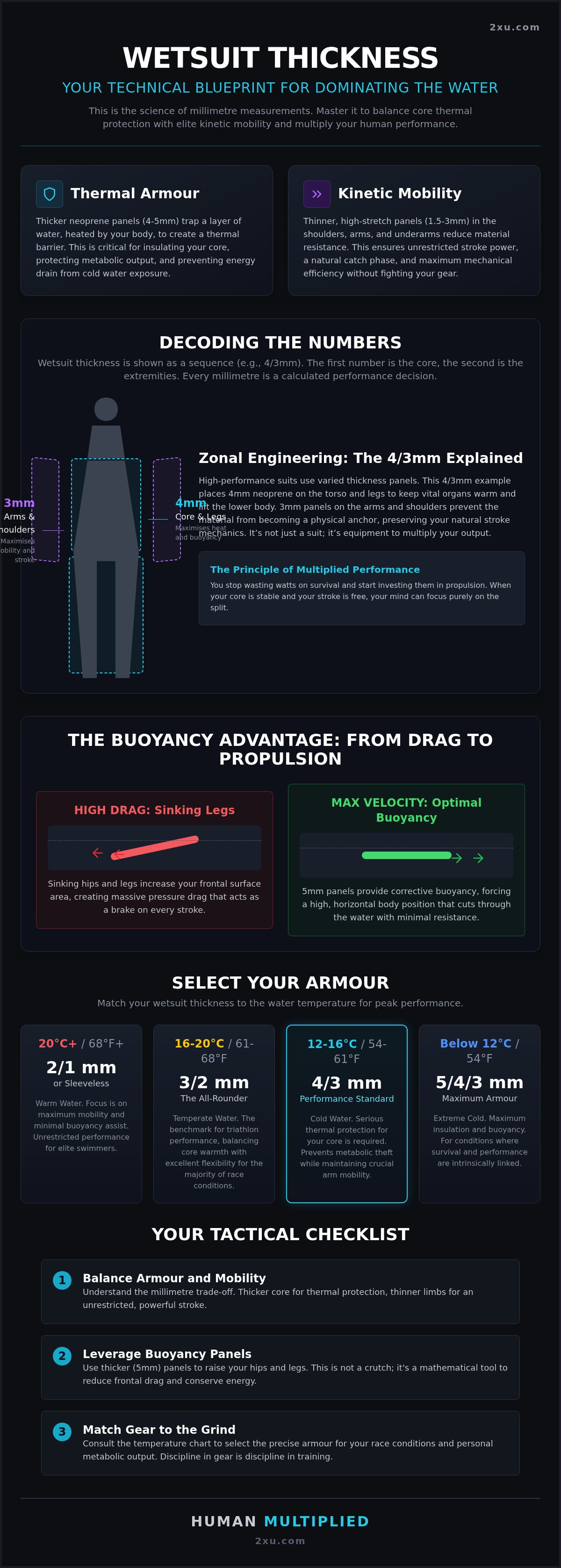
Wetsuit thickness is not a suggestion; it is a technical specification you must master to win. It is measured in millimetres, typically presented as a sequence of numbers such as 4/3 or 5/4/3. These digits represent the strategic distribution of neoprene across your body. The first number identifies the thickness at your core, where heat retention and buoyancy are paramount. The subsequent numbers indicate the tapering thickness in your extremities. This wetsuit thickness guide establishes that every millimetre is a calculated trade-off between thermal insulation and mechanical freedom. The Science of Wetsuit Thickness dictates that neoprene functions by trapping a thin layer of water against your skin, which your body then heats to create a thermal barrier. If this barrier is too thin, you lose heat. If it is too thick, you lose the race.
The 3/2mm and 4/3mm Nomenclature Explained
High-performance engineering requires the core to remain thicker than the limbs. A 4/3mm suit utilises 4mm panels on the torso to keep vital organs at optimal operating temperatures while 3mm panels on the arms and legs prevent the neoprene from becoming a physical anchor. This variance ensures you maintain a high elbow during the catch phase without fighting the material's resistance. Zonal thickness is the precise application of varying neoprene grades to specific anatomical regions to maximise both hydrodynamics and range of motion. In elite triathlon suits, this means using a 5mm panel to lift the hips while using thin, high-stretch panels under the arms to preserve your natural stroke mechanics. You don't just wear the suit; you use it to multiply your output.
Thermoregulation and Metabolic Efficiency
Cold water is a metabolic thief. When swimming in temperatures below 15°C, your physiology initiates a violent response to maintain homeostasis. It diverts oxygen-rich blood from your lats and triceps to your internal organs. This process increases your oxygen uptake for non-propulsive tasks, effectively lowering your functional threshold power in the water. A cold muscle is an inefficient muscle that is prone to cramping and premature fatigue. By selecting the correct thickness, you insulate your physiology against this energy drain. You stop wasting watts on survival and start investing them in propulsion. Respect the grind by ensuring your armour protects your metabolic output. Being race-ready means knowing your equipment has eliminated the variables that cause average athletes to fade. When your core is stable, your mind is free to focus on the split.
The Physics of Buoyancy: How Neoprene Multiplies Hydrodynamics
Buoyancy is the invisible engine of a fast swim split. Neoprene is a closed-cell foam infused with thousands of microscopic nitrogen gas bubbles. These gas pockets provide inherent lift, effectively reducing your functional density in the water. While average swimmers view flotation as a safety feature, elite athletes use it as a tool for Engineering Your Fastest Swim Split. By strategically placing 5mm neoprene panels in the lower body, you can force a horizontal body position that would otherwise require immense core strength to maintain over long distances. This wetsuit thickness guide prioritises the tactical application of lift to ensure you are cutting through the water, not dragging your way through it.
Body position is the single greatest determinant of swimming velocity. When your hips and legs sink, your frontal surface area increases, creating massive pressure drag that acts as a brake on every stroke. Thicker neoprene in the legs serves as a mechanical correction for "heavy legs," a common issue even among disciplined triathletes. This corrective buoyancy allows you to maintain a high position on the water's surface, shifting your physiology from a state of constant recovery to one of pure propulsion. Every watt you save on lift is a watt you can spend on the bike and run. Discipline in gear selection is just as critical as discipline in training.
Calculating Drag Reduction through Lift
The relationship between thickness and drag is linear. A 5mm leg panel provides significantly more upwards force than a 3mm panel, which is vital for athletes whose kick tends to drop as fatigue sets in. By increasing the thickness in the thighs and shins, you optimise your "hydrodynamic plane." This positioning reduces the energy cost of every metre covered, allowing for a more efficient stroke rate. If your legs are prone to sinking during the second half of a 3.8km swim, choosing a suit with maximal legal thickness in the lower extremities is not just a preference; it is a performance mandate. You can view our range of triathlon wetsuits to find the specific buoyancy profile that matches your technical needs.
Mechanical Stability and Core Support
Thickness does more than provide lift; it provides structural integrity. High-performance neoprene acts as a core wrap, stabilising your midsection and reducing lateral snaking. This mechanical stability ensures that the power generated from your shoulders is transferred directly into forward movement rather than being lost to inefficient side-to-side oscillations. For a deeper material analysis of how these panels are constructed, explore our guide on Neoprene Wetsuit Science. Mastering the wetsuit thickness guide means understanding that a thicker core panel doesn't just keep you warm; it keeps you straight. Respect the grind by choosing equipment that holds your form when your muscles begin to fail. This is where the concept of "human multiplied" becomes a tangible advantage on race day.
Wetsuit Thickness Temperature Chart: Selecting Your Performance Armour
Thermal management is a critical performance variable that average athletes frequently ignore. While a scuba diver might prioritise static warmth, a triathlete must account for the massive internal heat generated during high-intensity propulsion. Choosing a suit that is too thick for the conditions leads to thermoregulatory failure, causing your heart rate to spike and your power output to crater. Conversely, a suit that is too thin will leave you shivering, wasting precious glycogen on non-propulsive shivering. This wetsuit thickness guide provides the definitive temperature benchmarks required to match your equipment to the environment.
Water temperature dictates the legal and physical boundaries of your race. According to 2026 IRONMAN regulations, wetsuits are permitted for age-group athletes in water temperatures up to and including 24.5°C. When the water exceeds this threshold, you risk heat exhaustion. In these "non-wetsuit" conditions, you should transition to a high-performance triathlon suit to maintain hydrodynamics without the thermal burden of neoprene. For sanctioned events, follow these calibrated ranges:
- 19°C – 23°C (66°F – 73°F): Utilise a 2mm or 3/2mm suit. This profile offers maximum mobility and prevents overheating during high-cadence efforts.
- 14°C – 18°C (57°F – 64°F): A 4/3mm or a 3mm core is the standard for long-distance endurance. It provides the necessary insulation for extended exposure.
- Below 14°C (57°F): 5mm core panels are essential. At these temperatures, you must also consider thermal caps and booties to protect your extremities from cold-induced vasoconstriction.
Understanding The Physics of Buoyancy and insulation is vital because water conducts heat away from the body 25 times faster than air. Even in "mild" water, a 90-minute swim will steadily leach your core temperature if your suit isn't up to the task. Respect the grind by choosing the armour that protects your metabolic efficiency.
The Impact of Swim Duration on Thickness Choice
Duration changes the thermal equation. In a Sprint distance event, you can afford a thinner, more aggressive suit because the high intensity keeps your core temperature elevated for the short duration. However, during an IRONMAN-length split, the cumulative cooling effect of the water becomes a dominant factor. You must also account for your personal physiology. Athletes with lower body fat percentages or those prone to cold should lean toward the thicker end of the recommended range to preserve their muscular function for the bike leg.
Zonal Thickness: The Elite Compromise
The 5mm maximum thickness rule set by World Triathlon and IRONMAN is a hard limit you must respect. Elite engineering bypasses this restriction by using premium Yamamoto 39 and 40 Cell neoprene, which offers superior flexibility even at higher densities. To maintain a competitive edge, 1.5mm underarm panels are non-negotiable for elite stroke mechanics because they allow for an unrestricted reach and recovery. This zonal approach ensures that while your core stays buoyant and warm, your shoulders remain free to execute a powerful, high-elbow catch. Don't let your gear be the bottleneck in your performance.
Tactical Selection: Matching Thickness to Your Race Objectives
Your gear must match your ambition and the specific demands of the course. Open water is a volatile environment, not a controlled laboratory. If you are racing in choppy conditions with significant swell, high-buoyancy panels become a tactical necessity for effective sighting. A 5mm core allows you to stay high enough in the water column to spot buoys without breaking your rhythmic efficiency. This wetsuit thickness guide asserts that your equipment should solve environmental problems before they cost you time. You must also account for the salinity of the water. Saltwater provides natural lift, which may allow disciplined swimmers to opt for a thinner, more flexible suit. In freshwater lakes, however, you lose that assistance, making thicker neoprene essential to maintain your hydrodynamic plane.
Transition speed is the "fourth discipline" that many athletes overlook. While a thicker suit provides superior lift, it can be significantly harder to strip under the high-pressure environment of T1. Thicker 5mm panels in the ankles and wrists can bind during removal, potentially wasting the seconds you fought so hard to gain in the water. Respect the grind by practising your transitions in the same suit you intend to race in. Every millimetre of neoprene must justify its presence by either increasing your speed or protecting your physiology. Every choice in your wetsuit thickness guide strategy should account for the fatigue curve of your target race distance.
The IRONMAN Standard
Adhering to IRONMAN wetsuit rules requires a balance of compliance and performance. For a 3.8km swim, a 4/3mm configuration is often considered the "goldilocks" zone. It provides the core stability needed to prevent your form from collapsing during the final 1,000 metres while ensuring your shoulders aren't fatigued by excessive material resistance. This thickness profile ensures mechanical stability over long durations, keeping your skeletal alignment locked in even when your secondary stabiliser muscles begin to fail. Precision in selection is the hallmark of an elite athlete.
Training vs. Racing Thickness
Strategic athletes often utilise a thicker suit during heavy training blocks to build specific muscle endurance. Fighting the slight resistance of a more robust suit during your long sets prepares your lats and deltoids for the rigours of race day. When you finally switch to a high-mobility race suit with 1.5mm shoulder panels, you experience a "taper" effect where your stroke feels lighter and more powerful. To preserve this advantage, maintain your high-tech neoprene by rinsing it in fresh water after every session. Salt and chlorine degrade the cell structure of the foam, reducing its elasticity and buoyancy over time. To secure your tactical advantage on the starting line, shop our triathlon wetsuits and choose the armour that matches your mission.
Mastery of the Water: Why 2XU Engineering Outperforms
2XU engineering is the final piece of the performance puzzle. While other brands rely on generic templates, we utilise laboratory-validated zonal thickness to multiply your functional output. This wetsuit thickness guide has detailed the physics of the water; our suits are the physical manifestation of that data. We don't settle for average standards. We obsess over the millimetre. Every panel is placed with surgical precision to ensure you aren't just wearing a suit, but an advanced piece of athletic machinery designed to dominate the open water.
Our 520% stretch lining is a breakthrough in material science. It ensures that even when you require the thermal protection of a 5mm core, your power phase remains unrestricted. We have eliminated the mechanical resistance that traditionally plagues thicker suits, allowing for a natural, high-elbow recovery. By integrating proprietary buoyancy inserts into the core and upper legs, we force your body into an optimal hydrodynamic plane. This isn't just flotation. It is precision lift designed to keep you at the surface when the grind becomes unbearable. Every suit is the result of rigorous testing to ensure it meets the uncompromising demands of the elite athlete.
The Multiplication of Human Potential
2XU technology is designed to double down on your hard work. You spend months in the pool perfecting your catch and building your engine. Our engineering ensures that none of that effort is wasted on fighting your equipment. This is the transition from athlete to machine. When you zip into a 2XU suit, you are joining the ranks of those who refuse to accept average standards. You are choosing to multiply your potential through superior engineering and unyielding discipline. Earn your place at the front of the pack with gear that respects your ambition.
Engineered for the Transition
The race doesn't end at the water's edge. Our quick-release panels are engineered for the fastest T1 times in the industry. We have optimised the ankle and wrist cuffs to ensure they strip away the moment you reach your rack, saving you critical seconds when your heart rate is at its peak. This durability is built to withstand the rigours of a full race season, from the first practice swim to the final championship finish line. Respect the effort you've put into your training by choosing gear that won't fail you in the heat of competition. Explore the 2XU Triathlon Wetsuit Collection and find your elite armour today.
Execute Your Elite Swim Strategy
Mastering the science of neoprene is the difference between surviving the swim and dominating it. This wetsuit thickness guide has established that every millimetre is a tactical decision impacting thermal stability and hydrodynamic lift. You now understand that zonal engineering is not a luxury; it is a requirement to maintain elite stroke mechanics while forcing your hips into a faster body position. Respect the grind by choosing equipment that matches the intensity of your training. Average standards have no place on the starting line.
Our suits are the choice of World Champion triathletes who refuse to compromise on performance. By utilising proprietary 39 Cell neoprene technology, we provide the flexibility you need without sacrificing the core support required for long-distance endurance. Every panel is engineered for maximum hydrodynamic lift, ensuring your energy is spent on propulsion rather than survival. It's time to stop guessing and start engineering your results. Maximise your buoyancy with 2XU elite wetsuits. Your preparation has been relentless. Now, ensure your gear is capable of multiplying that effort. Go out and earn your place.
Frequently Asked Questions
What is the best wetsuit thickness for 15-degree water?
A 4/3mm or 3mm core suit is the objective standard for 15-degree water. This thickness provides the thermal insulation required to maintain core temperature during prolonged exposure without sacrificing kinetic mobility. In these conditions, you must protect your metabolic efficiency to ensure your muscles don't waste energy on shivering. Consult the wetsuit thickness guide temperature charts to ensure your armour matches the environmental demands of your specific course.
Can a wetsuit be too thick for triathlon racing?
Yes, exceeding the necessary thickness for the water temperature leads to thermoregulatory failure and premature fatigue. When a suit is too thick, your heart rate spikes as your body struggles to dissipate internal heat. Additionally, excessive neoprene in the shoulders can bind your stroke, destroying your mechanical efficiency. Elite performance requires a precise balance where you wear only the minimum thickness needed to maintain homeostasis and buoyancy.
What do the two numbers in wetsuit thickness (e.g., 3/2) mean?
The first number represents the millimetre thickness of the neoprene panels covering your core and torso for heat retention and lift. The second number indicates the thickness of the panels in the limbs, such as the arms and legs, designed for maximum range of motion. This dual-number nomenclature defines the zonal engineering of the suit, ensuring vital organs stay warm while your stroke remains unrestricted by heavy material.
Is a 5mm wetsuit legal for IRONMAN competitions?
A 5mm wetsuit is legal for IRONMAN competitions, as it represents the maximum thickness permitted under World Triathlon and IRONMAN sanctioned rules. Any suit exceeding 5mm in any panel will result in disqualification. Elite athletes often utilise this maximum limit in the lower body panels to achieve the highest possible hydrodynamic lift, effectively raising the hips to reduce frontal drag during the 3.8km swim split.
How does wetsuit thickness affect my swimming body position?
Thickness directly dictates your hydrodynamic plane by providing lift through nitrogen-infused neoprene cells. Thicker panels in the lower body act as a tactical correction for sinking legs, forcing your anatomy into a horizontal position on the water's surface. This reduction in frontal drag allows you to maintain velocity with lower energy expenditure. It is a mathematical advantage that multiplies your swimming efficiency by stabilising your skeletal alignment.
Should I choose a different thickness for saltwater vs. freshwater?
Saltwater is more dense than freshwater, providing natural lift that may allow you to opt for a slightly thinner, more flexible suit. In freshwater environments, you lose this assistance, making a suit with thicker lower-body panels essential to prevent your hips from dropping. Discipline in gear selection means accounting for water density to ensure your wetsuit thickness guide strategy maintains an optimal body position regardless of the race venue.
Does a thicker wetsuit restrict my shoulder movement?
Neoprene thickness can restrict shoulder mobility if the suit lacks laboratory-validated zonal engineering. High-performance suits bypass this issue by using ultra-thin, 1.5mm panels in the underarms and shoulders, even if the core is 5mm thick. This allows for an unrestricted catch and recovery phase. If you feel resistance during your pull, your suit's thickness distribution is likely mismatched to your biomechanical requirements, leading to unnecessary muscular fatigue.
How do I know if I need a thermal wetsuit?
You require a thermal wetsuit when water temperatures drop below 14°C or when your swim duration exceeds 90 minutes in sub-18°C conditions. These suits feature specialised internal linings designed to trap more body heat without adding excessive bulk. If you experience cold-induced vasoconstriction or a loss of fine motor control in your hands, your current armour is insufficient. Professional-grade thermal gear ensures your physiology remains focused on propulsion rather than survival.