
Triathlon Clothing: The Definitive Guide to Your Race Day System
In triathlon, every second and every watt of power output is critical. The wrong choice in triathlon clothing is more than an inconvenience-it's a direct compromise to your performance potential. Chafing, drag, and inefficient thermoregulation are variables you cannot afford on race day, turning months of dedicated training into a battle against your own gear.
This is not a guide to trends; it is a tactical manual for engineering your race day system. We will deconstruct the science behind advanced fabrics, the biomechanics of compression, and the aerodynamic advantages of a meticulously constructed suit. Forget the guesswork and marketing noise that leads to costly errors. Here, you will gain the intelligence to select the precise equipment for your distance and ambition.
The result: a faster, more efficient race where your apparel functions as an extension of your own power. Prepare to multiply your performance.
Key Takeaways
- Master the trisuit as the core of your race day system, engineered for seamless performance across swim, bike, and run.
- Maximize your swim leg performance by layering a wetsuit or swimskin over your trisuit to leverage buoyancy and hydrodynamic advantage.
- Understand how advanced triathlon clothing utilizes aerodynamics and compression to reduce drag and increase power output on the bike and run.
- Eliminate race day variables by rigorously testing your complete apparel system in training to guarantee performance when it counts.
The Foundation of Speed: Understanding the Triathlon Suit (Trisuit)
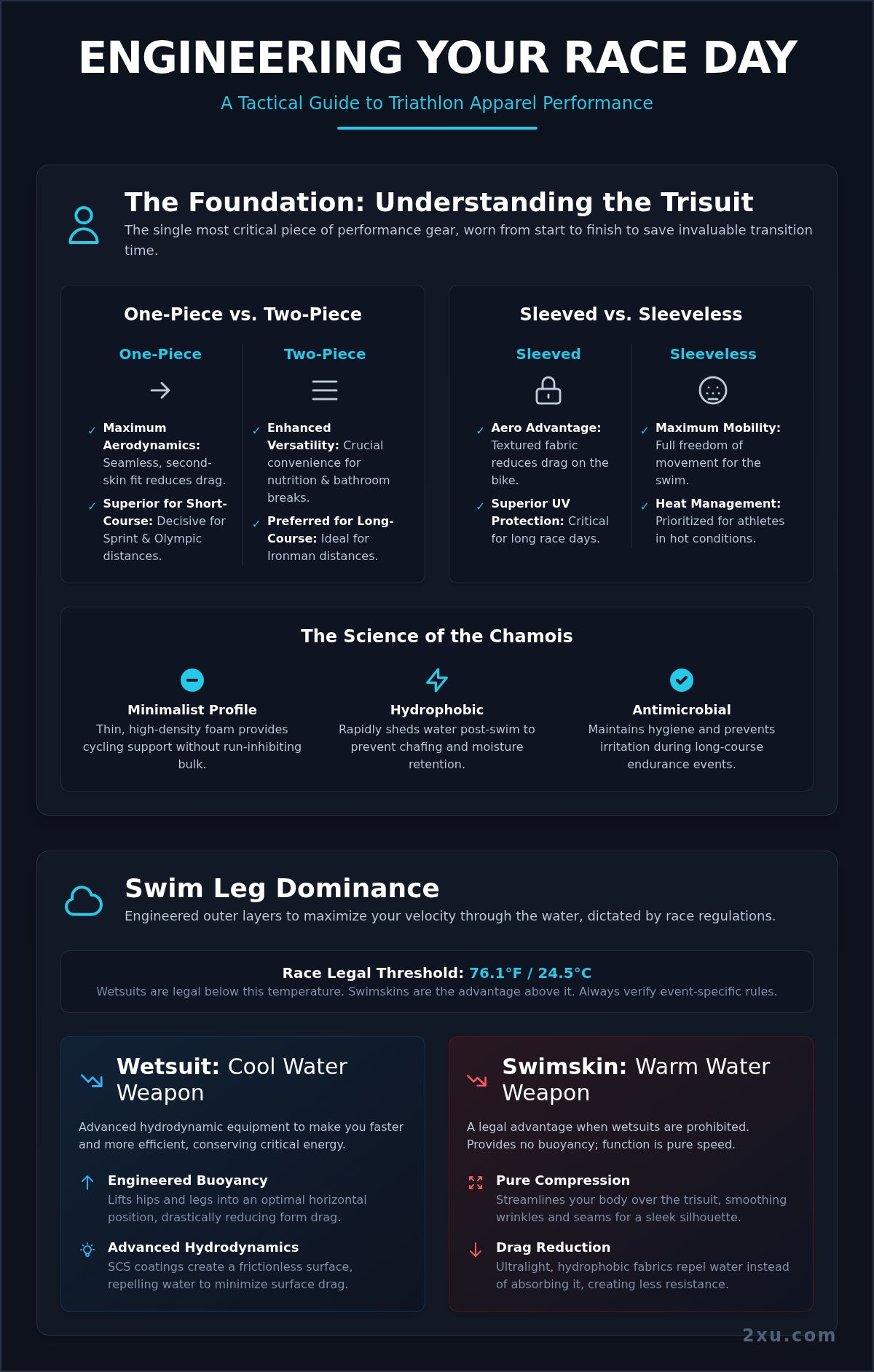
In the world of triathlon, where every second is meticulously accounted for, the trisuit stands as the single most critical piece of performance triathlon clothing. It is the core of your race-day system, an engineered garment designed to be worn from the starting cannon to the finish line. Its fundamental purpose is to eliminate the need for changing between disciplines, thereby saving invaluable time in transition. While the full scope of Triathlon equipment is vast, the trisuit is the non-negotiable foundation. This is achieved through a synthesis of advanced features: hydrophobic, quick-drying fabrics that shed water post-swim, a minimalist chamois for cycling comfort without run-inhibiting bulk, and a compressive, aerodynamic fit that reduces drag across all three legs of the race.
One-Piece vs. Two-Piece Trisuits
The choice between a one-piece and two-piece construction is a strategic decision based on race distance and personal preference. The one-piece suit offers maximum aerodynamic advantage and a seamless, second-skin fit, making it the superior choice for short-course (Sprint and Olympic) racing where marginal gains are decisive. Conversely, the two-piece design provides enhanced versatility and crucial convenience for nutrition and bathroom breaks, making it the preferred system for many long-course athletes tackling Ironman distances.
Sleeved vs. Sleeveless Designs
Sleeved trisuits have become the standard for competitive age-groupers and professionals for two scientifically validated reasons: superior UV protection and a significant aerodynamic advantage on the bike leg. The textured fabric on the sleeves helps to "trip" the air, reducing pressure drag. The sleeveless design, however, offers maximum freedom of movement and shoulder articulation for the swim, and remains a popular choice for beginners or athletes who prioritize heat management above all else.
The Science of the Chamois
Unlike a traditional cycling chamois, the triathlon-specific pad is an engineering marvel of minimalism and function. It is constructed from thin, high-density, and hydrophobic foam to provide critical support on the bike while rapidly shedding water after the swim. This ensures it doesn't create abrasive bulk or retain moisture on the run. Advanced models are treated with antimicrobial properties, a crucial feature for maintaining hygiene and preventing irritation during the extreme endurance demands of long-course racing.
Swim Leg Dominance: Wetsuits and Swimskins Engineered for Speed
The triathlon swim is a battle for position, and your equipment is your armor. Your trisuit serves as the foundational layer, a second skin you will wear for the entire race. Over this, depending on water temperature, you will wear a specialized outer layer engineered for a singular purpose: maximizing your velocity through the water. This is not just about comfort; it is a calculated decision in your performance strategy.
Race regulations dictate your choice. Both USA Triathlon (USAT) and IRONMAN deem wetsuits race-legal in water temperatures up to 76.1°F (24.5°C) for most age-group events. Above this threshold, wetsuits are prohibited to prevent overheating, and the swimskin becomes your critical performance tool. Always verify the specific rules for your event, as they can vary.
Wetsuit Technology: More Than Just Warmth
A modern triathlon wetsuit is a piece of advanced hydrodynamic equipment. It is engineered to make you faster and more efficient, conserving critical energy for the bike and run. The benefits are scientifically validated and non-negotiable for any serious competitor in a wetsuit-legal swim.
- Engineered Buoyancy: Premium neoprene is strategically paneled to lift the hips and legs, forcing an optimal horizontal body position. This elevation drastically reduces form drag, allowing you to slice through the water with less effort.
- Advanced Hydrodynamics: Proprietary coatings like SCS (Super Composite Skin) create an almost frictionless surface, actively repelling water to minimize surface drag and increase speed.
- Unrestricted Mobility: Anatomically designed shoulder and arm panels, often using thinner and more flexible neoprene, ensure a full range of motion. This allows for maximum power output and an efficient stroke without fatigue.
Find the wetsuit engineered for your next PR.
Swimskins: The Warm Water Weapon
When the water is too warm for a wetsuit, a swimskin is your legal advantage. Unlike a wetsuit, it provides no significant buoyancy. Its function is pure compression and drag reduction. This advanced piece of triathlon clothing is meticulously constructed from ultralight, hydrophobic fabrics that repel water instead of absorbing it. The compressive fit streamlines your body over your trisuit, smoothing out wrinkles and seams to create a unified, sleek silhouette. This is where advanced material science, supported by research on triathlon suit performance, makes a measurable difference in your swim split. A swimskin is the weapon of choice for dominating a non-wetsuit swim.
Bike & Run Performance: Aerodynamics, Compression, and Thermoregulation
Once out of the water, your trisuit's true purpose is revealed. It is not merely apparel; it is an engineered system designed to multiply your performance on land. The transition from swim to bike is where advanced triathlon clothing demonstrates its value, transforming from a hydrodynamic layer into a weapon against drag, muscle fatigue, and heat.
The Aerodynamic Advantage
Seconds are earned through superior science. Modern trisuits leverage strategically placed textured fabrics, particularly on the sleeves and shoulders, to create turbulent boundary layers that reduce pressure drag. This meticulous engineering is validated through rigorous wind-tunnel testing. However, the most critical factor remains fit; a compressive, second-skin silhouette is non-negotiable to eliminate fabric flutter and minimize wind resistance. Every design element must be optimized for speed while adhering to the official USA Triathlon competitive rules that govern garment construction.
Muscle Containment and Support
Your power output is finite. Advanced compression technology is engineered to preserve it. By applying graduated, targeted pressure to key muscle groups, a high-performance trisuit drastically reduces muscle oscillation-the damaging vibration that occurs upon impact. This containment minimizes micro-tears and delays neuromuscular fatigue, allowing you to sustain a higher power output for longer. Technologies like 2XU's proprietary Muscle Containment Stamping (MCS) apply this principle with anatomical precision, providing a framework of support to the quads and glutes for superior performance on the bike and run.
Staying Cool Under Pressure
Managing core temperature is fundamental to endurance. Elite triathlon clothing employs advanced fabric technologies engineered for maximum thermoregulation. These materials utilize hydrophobic yarns to wick sweat relentlessly from the skin to the garment's surface, where it can rapidly evaporate. This process is augmented by:
- Strategic Ventilation: Mesh panels are precisely placed in high-heat zones like the back and underarms to maximize airflow.
- Heat-Reflective Technology: Advanced treatments on dark-colored fabrics help reflect infrared rays, performing like light-colored materials to keep you cooler under direct sun.
- Light-Colored Fabrics: In the absence of specific treatments, lighter colors provide a baseline advantage by naturally reflecting more solar radiation.
Essential Race Day Accessories: The Final Layer of Performance
Your trisuit is the engine of your race day apparel, but victory is secured by integrating a complete performance system. Accessories are not afterthoughts; they are scientifically engineered tools designed to eliminate distractions, enhance efficiency, and multiply your power output. A truly optimized triathlon clothing setup accounts for every variable, creating a seamless system that allows you to focus solely on the physical and mental demands of the race. Mediocrity has no place on the podium.
We categorize these critical components by their primary function: efficiency, support, and protection.
Transition and Race Essentials
Every second saved is a competitive advantage. This equipment is engineered for speed, comfort, and unwavering focus when fatigue sets in.
- Race Belt: Eliminate the friction and fabric damage of safety pins. A dedicated race belt allows for sub-second race number attachment in transition, ensuring a secure and comfortable fit for the bike and run.
- Triathlon-specific Socks: Do not compromise your run with standard athletic socks. Engineered with advanced moisture-wicking fibers and a seamless construction, these socks prevent blisters and maintain foot stability, a critical factor in late-race performance.
- Visor or Hat: Essential for thermoregulation and protection. A lightweight performance visor shields your vision from solar glare while wicking sweat, helping maintain a lower core temperature so you can push harder, for longer.
Compression Accessories for Support and Recovery
Your equipment must not only perform during the race but also prepare you for what comes after. Advanced compression accessories are a pivotal part of the complete triathlon clothing system, offering adaptable support that can be added or removed during transitions.
- Calf Guards/Sleeves: Engineered to reduce muscle oscillation during the high-impact run leg. This containment of the calf muscle minimizes micro-tears and damage, directly combating fatigue and significantly accelerating post-race recovery.
- Arm Sleeves: A versatile tool for managing environmental variables. Our proprietary fabrics offer superior UV protection and thermoregulation, keeping you cool in direct sun and warm in cooler conditions. They can be pulled on in T1 or T2 to adapt to the changing race environment without losing momentum.
Integrate these advanced tools into your race day protocol. Explore the engineered accessories designed to complete your system and multiply your human performance.
Building Your Kit: From Training Essentials to Race Day Armor
Constructing your triathlon clothing arsenal requires a strategic approach. Your training gear is built for volume and durability, withstanding countless hours of work. Your race day kit, however, is your armor-an engineered system designed for a singular purpose: maximum performance with zero compromise. The cornerstone of this system is a high-performance trisuit. Invest in the best core garment you can; its impact on your aerodynamics, thermoregulation, and comfort is scientifically proven to affect your output.
The cardinal rule of racing is absolute: nothing new on race day. Every single piece of your kit-from your trisuit to your socks and race belt-must be tested under race-intensity conditions during training. This rigorous validation process eliminates variables and prevents catastrophic failures like chafing, overheating, or gear-induced discomfort that can degrade performance when it matters most. Your preparation must be as meticulous as your ambition.
Sprint & Olympic Distance Kit
For shorter distances, every second is critical. Your kit must prioritize aerodynamic efficiency and speed. A sleeved one-piece trisuit offers a distinct advantage against the wind. Minimalism is key; eliminate any non-essential gear that adds weight or drag. Your focus is pure, unadulterated velocity.
- Engineered sleeved one-piece trisuit
- Performance goggles and swim cap
- Lightweight race belt
- Wetsuit (scientifically selected for expected water temperature)
Half & Full IRONMAN Distance Kit
Endurance racing shifts the priority from pure speed to a balance of comfort, versatility, and sustained performance. Your triathlon clothing must support you for hours. A two-piece suit or a one-piece with integrated storage becomes essential for nutrition. Sun protection is non-negotiable, making sleeved suits and arm coolers critical components. Advanced compression gear is vital to contain muscle oscillation, reduce fatigue, and enhance blood flow over the grueling distance.
- One or two-piece trisuit with nutrition storage
- Compression socks or calf sleeves for muscle containment
- UV-protective arm coolers
- Performance visor or cap
- Wetsuit
Your race kit is more than just clothing; it is a calculated weapon in your pursuit of peak performance. Mediocrity is not an option. Engineer your complete race day system with 2XU.
Engineer Your Next Personal Best
Mastering your race day execution begins with a meticulously engineered apparel system. As this guide has detailed, your trisuit forms the core of your strategy, providing a seamless foundation for all three disciplines. However, true dominance is achieved by layering specialized equipment-hydrodynamic wetsuits, aerodynamic cycle gear, and thermoregulating run apparel-to maximize efficiency at every stage. The right triathlon clothing is not merely about comfort; it is a calculated investment in speed, endurance, and power output, providing a critical advantage from the start cannon to the finish chute.
To multiply your human performance, you need gear built on a foundation of science, not compromise. Trusted by world champion athletes and IRONMAN winners, 2XU apparel is engineered with scientifically validated fabrics and advanced compression technology. This construction is proven to reduce muscle oscillation, combat fatigue, and enhance your power for longer. Every stitch, panel, and fabric is optimized for a single purpose: making you faster.
Your potential is waiting to be unlocked. Equip yourself with the world's most advanced technical apparel. Shop the Triathlon Collection Engineered for Peak Performance. Now, go conquer your race.
Frequently Asked Questions
Do you wear underwear with triathlon shorts or a trisuit?
No. This is a non-negotiable for performance. All high-performance triathlon clothing is engineered with an integrated, quick-drying chamois designed for direct skin contact. Wearing underwear introduces fabrics that retain moisture, leading to significant chafing and friction. This degrades performance across all three disciplines. For optimal function and to prevent abrasion, the engineered chamois must be worn as intended-directly against the skin. Eliminate all unnecessary layers.
How should triathlon clothing fit? Should it be extremely tight?
The fit must be compressive and aerodynamic, but not restrictive. Your gear should feel like a second skin to minimize drag in the water and on the bike. This precise, firm fit also supports key muscle groups, reducing muscle oscillation and delaying fatigue. If the garment is loose, it will create drag and cause chafing. If it restricts breathing or range of motion, your power output will be compromised. The fit is engineered for maximum efficiency.
Can you use a regular cycling jersey and shorts for a triathlon?
This is a suboptimal strategy that will impede your performance. A standard cycling chamois is excessively thick, absorbing significant water during the swim and creating a heavy, abrasive burden on the run. Cycling jerseys are not designed for hydrodynamics. Purpose-built trisuits utilize a low-profile, quick-drying chamois and hydrophobic fabrics, engineered for seamless transitions and peak efficiency across all three stages of the race. Choose equipment specifically designed for the demands of the sport.
What is the difference between a triathlon wetsuit and a surfing wetsuit?
The engineering objectives are fundamentally different. A triathlon wetsuit is a piece of performance equipment designed for speed and efficiency. It uses variable neoprene thickness-thinner panels in the shoulders for maximum range of motion and thicker panels in the legs and core for optimized buoyancy. The exterior features a hydrophobic coating to reduce drag. Conversely, a surfing wetsuit prioritizes durability and warmth over flexibility and speed, often restricting the precise movement required for an efficient swim stroke.
How do I care for my trisuit and wetsuit to make them last longer?
Proper maintenance is critical to preserving the integrity of your high-performance gear. Immediately after use, rinse both your trisuit and wetsuit thoroughly with cold, fresh water to remove chlorine, salt, and sweat, which degrade technical fabrics and neoprene. Never use a washing machine or dryer. Hang them to air dry inside-out, away from direct sunlight or heat sources. UV exposure and heat will break down the materials, compromising their compressive and hydrophobic properties.
What do I wear for a pool swim triathlon vs. an open water swim?
For a pool swim, a trisuit or tri shorts and top are sufficient, as wetsuits are typically prohibited. For an open water swim, your choice is dictated by water temperature and race regulations. If the water is cold enough to be wetsuit-legal, a triathlon wetsuit worn over your trisuit is the superior choice for warmth, buoyancy, and speed. In warmer open water events where wetsuits are not permitted, a trisuit alone is the required and most efficient option.