
Avoiding Wetsuit Neck Chafe: The Elite Athlete’s Zero-Friction Guide
A raw, bleeding neck at T1 isn't a badge of honour; it's a sign of a failed technical protocol. For the elite athlete, avoiding wetsuit neck chafe is just as critical as power phase mechanics or aerobic threshold management. If your head rotation is restricted by the fear of salt-water sting, you aren't just losing skin. You are leaking seconds on every stroke.
You understand the grind of a 3.8km swim split and the frustration when a poorly positioned collar turns your session into a test of pain tolerance. Your focus must remain on hydrodynamics and propulsion, not the abrasive friction of neoprene against your dermal layers. We agree that performance should never be compromised by preventable mechanical irritation or disrupted technique.
This guide will show you how to master the mechanics of friction and engineer a zero-chafe environment through elite-level suit architecture and precise application techniques. We will deconstruct the science of neck seal technology, validate the use of specific lubricants, and provide the exact protocols required to maintain skin integrity through to the run leg. Prepare to multiply your output by eliminating the distractions that slow you down.
Key Takeaways
- Deconstruct the mechanical friction and salt crystal "micro-blade" effect that compromise your dermal integrity during high-volume swims.
- Engineer a zero-chafe split by selecting wetsuit architecture featuring low-profile, single-seam collar construction to minimise drag.
- Execute the "Double-Layer" protocol with silicone-based balms to maintain a friction-free barrier across the entire 3.8km swim leg.
- Master the "Suit Hike" technique for avoiding wetsuit neck chafe by eliminating material tension before you enter the water.
- Transition to the run with zero abrasions by utilising 2XU neck seal technology designed for elite-level hydrodynamic performance.
The Science of Friction: Why Wetsuit Neck Chafe Occurs
Mechanical friction in the context of neoprene-to-skin contact is the tangential force generated by the repetitive relative motion between the suit's collar and the dermal surface during the swim stroke. For the elite triathlete, this isn't merely an inconvenience. It is a calculated risk to performance. Every bilateral breath requires a specific degree of neck rotation; in a standard 3.8km Ironman swim, this equates to thousands of repetitive oscillations. If the interface between your skin and the suit isn't optimised, you are effectively sanding your neck for over an hour. Avoiding wetsuit neck chafe requires a deep understanding of these mechanical interactions.
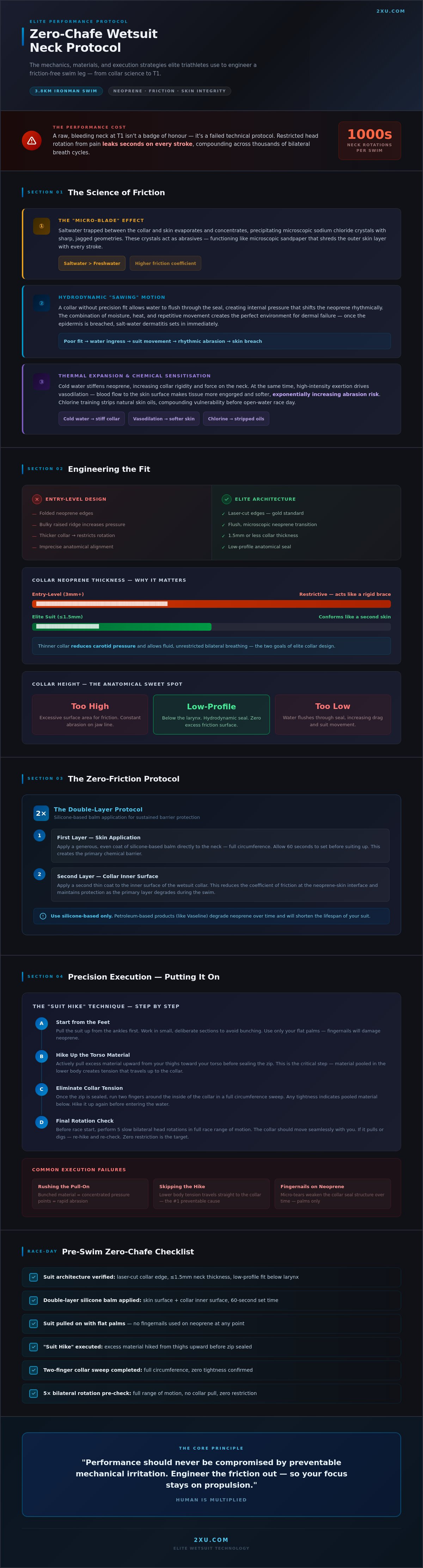
The primary catalyst for tissue breakdown is often what we call the "Micro-Blade" effect. As you swim, saltwater trapped between the collar and your skin begins to evaporate or concentrate. This leads to the precipitation of microscopic sodium chloride crystals. These crystals have sharp, jagged geometries that act as abrasives. When trapped within the collar seal, they function like microscopic sandpaper, shredding the stratum corneum with every stroke. This is why saltwater swims often result in more severe abrasions than freshwater sessions.
Hydrodynamic drag also plays a significant role in suit movement. A collar that lacks a precision fit allows water to flush through the seal, creating internal pressure that shifts the neoprene. This creates a rhythmic "sawing" motion against the skin. According to The Science of Friction, the combination of moisture, heat, and repetitive movement creates the perfect environment for dermal failure. Once the epidermis is breached, the biological impact is immediate. You face secondary salt-water dermatitis, an inflammatory condition where salt and bacteria penetrate the lower skin layers, causing intense stinging and potential scarring.
The Role of Salt and Chlorine
The friction coefficient of saltwater is significantly higher than that of freshwater. When salt dries at the neckline during a long-course event, it creates a permanent abrasive layer that accelerates tissue damage. Additionally, many athletes train in chlorinated pools. Chlorine residue can sensitise the skin by stripping away natural oils, making the epidermis far more vulnerable to mechanical friction before you even enter open water.
Thermal Expansion and Skin Sensitivity
Water temperature directly affects neoprene flexibility. In colder conditions, neoprene becomes less pliable, increasing the rigidity of the collar and the force it exerts on the neck. Simultaneously, your body's thermoregulation during high-intensity exertion leads to vasodilation. Increased blood flow to the skin surface makes the tissue more engorged and softer, which exponentially increases the risk of abrasion from the stiffened suit edges.
Engineering the Fit: How Wetsuit Architecture Prevents Chafing
Elite performance is built on the elimination of friction-induced variables. While entry-level suits often rely on traditional folded neoprene edges, these create a bulky, raised ridge that increases the pressure against your skin. This design flaw is a primary driver of abrasion. High-performance architecture utilises single-seam collar construction or, ideally, laser-cut edges. Laser-cutting is the gold standard for zero-abrasion interfaces because it creates a flush, microscopic transition between the neoprene and your dermal surface. By removing the physical "lip" of the collar, you effectively neutralise the sawing motion that occurs during every stroke.
Material density is equally critical. You need maximum flexibility at the neck to maintain a natural head rotation. Elite suits utilise thinner neoprene, typically 1.5mm or less, around the collar. This reduction in density serves two purposes. First, it decreases the restrictive pressure on your carotid artery and windpipe. Second, it allows the collar to conform more precisely to your anatomy, which is vital for avoiding wetsuit neck chafe. When the material is thinner, it behaves more like a second skin and less like a rigid brace, allowing for fluid, unrestricted bilateral breathing.
Collar Height and Anatomical Alignment
Precision fit requires a collar that aligns with your specific neck morphology. If a collar is too high, it creates excessive surface area for friction; if it's too low, it allows water to flush, increasing drag and suit movement. The goal is a "Low-Profile" seal that sits comfortably below the larynx but high enough to maintain a hydrodynamic barrier. High-performance triathlon wetsuits are engineered to balance this stability with shoulder flexibility. When your shoulders move through the recovery phase of the stroke, the neck seal must remain static. Any downward pull from the arm panels will compromise the neck seal, leading to immediate skin irritation.
Internal Lining Technology
What happens inside the suit is just as important as the exterior coating. Silk-smooth inner linings are designed to reduce shear force by allowing the suit to slide over the skin during high-intensity efforts. We use specialised materials that maintain their low-friction properties even when saturated with salt water. Understanding The Science of Friction reveals that moisture and movement are the enemies of skin integrity. To protect these engineered linings, you must avoid petroleum-based lubricants like Vaseline. These substances will degrade the neoprene structure over time, causing it to lose its elasticity and smooth finish. Stick to silicone-based or lanolin-heavy alternatives to preserve your gear. If you are serious about your swim split, it’s time to invest in precision-engineered triathlon wetsuits that respect the mechanics of your body.
The Zero-Friction Protocol: Tactical Lubrication and Protection
Preparation is the difference between an elite swim split and a DNF caused by avoidable dermal failure. While suit architecture provides the foundation for performance, avoiding wetsuit neck chafe during high-volume sessions requires a rigorous lubrication protocol. You must view lubrication as a mechanical barrier, not a cosmetic application. This means selecting agents based on their viscosity, water-solubility, and chemical compatibility with your equipment. Lanolin and silicone-based balms are the industry standard for a reason. They provide a high-friction-reduction coefficient that remains stable even when exposed to fluctuating water temperatures and salt concentrations.
The "Double-Layer" technique is the only way to ensure total protection. Most athletes make the mistake of only greasing their skin. For zero-friction results, you must apply the lubricant to your neck and the internal collar of the suit. This creates a lubricant-on-lubricant interface, allowing the neoprene to slide over the skin with zero shear force. You must target the primary friction zones where the suit is most likely to "bite" during rotation. These include the thyroid cartilage (Adam's apple), the area surrounding the occipital bone behind the ears, and the lower trapezius line. A standard 90-minute swim requires a barrier that won't wash away after the first 400 metres.
The Anti-Chafe Toolkit
Durability is the primary metric for your toolkit. While sprays offer convenience for quick training sessions, balms provide a thicker, more resilient barrier for race day. You must avoid petroleum jelly at all costs. Petroleum-based products will compromise the cellular structure of your neoprene wetsuit, leading to material degradation and loss of elasticity. For ultra-distance events or athletes with extreme skin sensitivity, adding a specialised "neck skin" or a thin rash guard can provide a physical layer of protection that eliminates skin-to-neoprene contact entirely.
Race Day Application Strategy
Precision Execution: Putting on Your Wetsuit for Zero Abrasion
Execution is the final barrier between elite hydrodynamics and a failed swim leg. You can own the most advanced equipment, but if the material tension isn't correctly redistributed, you are inviting friction. The most common technical error in avoiding wetsuit neck chafe is failing to eliminate downward pull from the shoulders. If the suit is tight across the trapezius muscles, it will drag the collar seal into the soft tissue of your neck. This creates a mechanical pinch that turns into an abrasion within the first 500 metres of your swim.
The "Suit Hike" protocol is your mandatory pre-race ritual. You must systematically pull every centimetre of neoprene toward your torso. Start at the ankles and work the material up to the crotch, ensuring there is zero air space or tension in the legs. Once the lower body is seated, repeat this process for the torso. You need to gather enough slack in the chest and back so the shoulder seams sit perfectly flush. Use the Zipper Test: if you feel the collar pulling down when you rotate your head, the suit isn't high enough. A symmetry check is also vital. Use a partner or a mirror to verify the collar isn't bunched or folded on one side, as asymmetrical tension is a primary cause of unilateral scarring.
Step-by-Step: The Elite Fit
- Step 1: Pull the leg panels high into the crotch. This creates the necessary slack for the upper body and prevents the suit from dragging during the kick phase.
- Step 2: Work the neoprene up the torso and into the armpits. There should be no gap between the suit and your skin in the axillary region to ensure total range of motion.
- Step 3: Align the shoulder seams with the acromion process. This ensures the arm panels move with your deltoids rather than pulling against the neck seal during the recovery stroke.
- Step 4: Secure the neck tab. You must maintain a two-finger gap between the seal and your skin. This provides enough room for breathing and thyroid expansion without allowing water to flush the suit.
The 'Wet Entry' Adjustment
Never consider your fit finalised until you are in the water. A "Wet Entry" involves letting a small amount of water into the suit through the neck seal. This water acts as a secondary lubricant, allowing the internal lining to seat itself against your skin. Once the material is wet, perform one final hike of the shoulders to ensure the collar is sitting in its optimal anatomical position. Final adjustments to the neck seal once the material is lubricated by water are the final step in avoiding wetsuit neck chafe before you cross the timing mat. Respecting the grind means taking the extra five minutes in transition to get this right. A perfectly fitted suit is a weapon; a poorly fitted one is a liability. For gear that respects these mechanical principles, explore our range of performance-engineered triathlon wetsuits to ensure your next swim split is friction-free.
Multiply Your Performance with 2XU Wetsuit Technology
Protocol and preparation are the software of your performance; your wetsuit is the hardware. You can execute the perfect suit hike and apply the most resilient lubricants, but if the underlying architecture of your gear is flawed, you'll still face mechanical failure. 2XU engineering is built on the premise that avoiding wetsuit neck chafe should be a baseline expectation, not a race-day gamble. We don't just manufacture apparel. We engineer hydrodynamic systems that multiply your physical output by removing the friction that slows you down. Every millimetre of our collar architecture is a result of rigorous laboratory validation and feedback from the world's most demanding elite coaches.
Our commitment to performance isn't based on marketing claims; it's grounded in data. We collaborate with leading sports scientists to ensure that our material density and seam placements are mathematically optimised for the human stroke. By using specialised measurement instrumentation, we've refined our neck seals to maintain a consistent pressure profile across thousands of repetitions. This scientific approach ensures that your dermal integrity remains intact, allowing you to focus entirely on your power phase and head rotation. When you invest in a 2XU suit, you're investing in gear that respects the grind of your training and the ambition of your race goals.
The 2XU Advantage
The proprietary 2XU neck seal technology is designed to provide 360-degree mobility without compromising the hydrodynamic barrier. While inferior suits rely on rigid structures that bite into the skin, our low-profile architecture conforms to your anatomy, even during high-intensity bilateral breathing. Furthermore, our engineered buoyancy profiles do more than just keep you high in the water; they stabilise your core to reduce the lateral sawing movement that causes neck irritation. This mechanical stability is critical for maintaining a zero-friction interface. Additionally, our neoprene is treated to resist the corrosive effects of salt and chlorine, ensuring that your suit maintains its silk-smooth finish and elite performance characteristics season after season.
Ready for the Next Level?
Refusing to compromise on your gear is a hallmark of the elite athlete. If you're tired of suffering through avoidable abrasions and want to focus on breakthrough mathematical improvements in your swim splits, it's time to upgrade your hardware. Join the global community of triathletes who trust 2XU to protect their skin and multiply their performance. Don't let a preventable mechanical failure dictate your results. Shop 2XU Triathlon Wetsuits and dominate your next swim with the confidence that only precision engineering can provide. Your best performance is waiting on the other side of the zero-friction protocol.
Master the Interface: Secure Your Zero-Friction Split
Chafing isn't a cost of entry; it's a mechanical variable you must control. By mastering the science of friction and executing a meticulous suit-hike protocol, you turn a potential weakness into a performance advantage. You've learned that avoiding wetsuit neck chafe requires more than just a layer of balm. It demands precision-engineered architecture and a disciplined approach to every stage of your preparation.
2XU wetsuits are engineered for zero-friction performance, utilising scientifically validated hydrodynamic materials that have been proven on the world's most demanding courses. This is why our technology is the choice of elite IRONMAN champions who refuse to let dermal irritation disrupt their head rotation or slow their split. Your commitment to the grind deserves gear that matches your ambition and protects your skin through the longest sets.
Engineer your fastest swim with 2XU Wetsuits and eliminate the distractions that hold you back. Step into the water with the confidence that your equipment is as prepared for the challenge as you are. Earn your place at the front of the pack through hard work and superior engineering.
Frequently Asked Questions
Is it normal for a wetsuit to chafe your neck during the first few swims?
It is not an inevitability. While you might experience a brief adjustment period as you refine your "suit hike" technique, persistent abrasions indicate a mechanical failure. Avoiding wetsuit neck chafe requires a precision fit from your very first session. If the collar is digging into your skin, re-evaluate the positioning of the neoprene rather than waiting for your skin to toughen up through repeated injury.
Can I use Vaseline to stop my wetsuit from chafing?
You must never use Vaseline or any petroleum-based products on your equipment. These substances compromise the cellular integrity of the neoprene, causing the material to lose elasticity and develop a rough, abrasive texture. Stick to silicone-based or lanolin balms designed specifically for triathlon. These engineered lubricants provide a durable barrier without damaging the high-performance materials that provide your buoyancy and speed.
How can I tell if my wetsuit is too small in the neck?
A suit is too small if it restricts your thyroid expansion or exerts excessive pressure on your windpipe during bilateral breathing. Use the "two-finger test" at the neck tab; you should be able to slide two fingers between the seal and your skin without force. If the collar feels like a rigid brace that limits head rotation, the material is likely overstretched, which exponentially increases friction.
Do all triathlon wetsuits cause neck chafe?
Not all suits are engineered equally. High-performance models utilise single-seam or laser-cut collar architectures specifically designed to minimise the friction coefficient. While entry-level suits often feature bulky folded edges that "saw" against the skin during movement, elite 2XU technology focuses on a low-profile seal. Chafing is a result of poor engineering, incorrect fit, or failed protocol, not an inherent property of the sport.
What is the best way to treat a wetsuit neck burn after a swim?
Immediate decontamination is your first priority. Rinse the area with fresh water to remove salt crystals and bacteria, then apply a non-greasy antiseptic cream. Once the skin is clean, use a high-quality barrier cream to maintain moisture and prevent secondary salt-water dermatitis; to find professional-grade skin care that supports recovery, check out Ferrarucci Cosmetics. Protect the area from further friction until the epidermis has fully regenerated to avoid permanent scarring and disrupted training cycles.
Can a rash guard be worn under a wetsuit to prevent chafing?
A rash guard or "neck skin" can provide a physical barrier, but it should be viewed as a secondary solution for a poorly fitted suit. While it eliminates skin-on-neoprene contact, it can introduce new variables like water flushing or increased bulk around the larynx. Focus on avoiding wetsuit neck chafe through proper suit architecture and lubrication first. If you must use one, ensure it is extremely thin.
How do I clean my wetsuit to remove salt and lubricant buildup?
Thoroughly rinse your suit in fresh water after every session to eliminate sodium chloride precipitation. For lubricant buildup, use a specialised wetsuit shampoo that breaks down oils without damaging the neoprene cells. Avoid harsh detergents or heat, as these will dry out the material and create a brittle surface. A clean suit maintains its silk-smooth internal lining, which is essential for reducing shear force during the swim.
Does the type of swim stroke affect neck chafing?
Stroke mechanics significantly influence abrasion risk. If you lift your head too high or over-rotate during bilateral breathing, you create excessive vertical and lateral movement at the collar line. This rhythmic "sawing" motion accelerates tissue breakdown. Elite athletes focus on a neutral neck position and a clean rotation around the longitudinal axis to minimise suit-to-skin interference and maintain hydrodynamic efficiency throughout the entire swim split.