

You did everything right on Sunday. Thirty kilometres, controlled pace, felt strong the whole way. You stretched, you ate, you slept.
Then Tuesday came, and your legs felt like they were made of lead.
Not sore exactly. Heavy. Every runner who has trained through a marathon block knows the feeling: an easy run that turns into wading through molasses, legs that will not respond, and no obvious reason why. You were fine yesterday. Today you are wrecked.
There is a name for this among coaches. They call it second-day syndrome, because the soreness from a hard effort often peaks not the next morning but the one after, when you least expect it and are least prepared for it.
Here is what almost no one tells you: it is not a fitness problem, and it is not a sign you are weak. It is a mechanical one. And once you understand what is actually happening to your legs, you can do something about it.
What happens 90 times a minute
Every time your foot hits the ground while running, it lands with a force of around three times your body weight. That shock travels up through the leg as a wave. Your quads and calves absorb it, and in doing so they judder, a tiny high-frequency vibration on every single stride.
Now do the arithmetic. You take roughly 90 strides per leg per minute. On a long run that is tens of thousands of small impacts, each one making the muscle oscillate and each oscillation causing a little more micro-damage to the fibres.
That accumulated damage is a big part of what you feel on Tuesday. The muscle spent Sunday being battered at the cellular level, then spent 48 hours mounting an inflammatory response, and the peak of that response is the heavy, leaden feeling that ambushes your next run.
The oscillation is the villain. Most runners have never heard of it.
Why rest and foam rolling miss
So what do people reach for? Rest, foam rolling, ice baths, a rest day, then another one.
None of those touch the actual cause. Rest helps clear the metabolic waste eventually, but slowly, and it does nothing to stop the oscillation happening in the first place. A foam roller works on the muscle after the fact; it cannot reach into a run and stop your quads juddering on every stride. Ice baths blunt soreness but research now suggests they also blunt the training adaptation you are chasing, which is the whole point of the block.
And the cruel part is that the obvious fix, more rest, costs you the thing you are most afraid of losing this close to race day: fitness. Take too many days off and the heavy legs go away, but so does your edge.
You do not need more rest. You need less oscillation.
The lever almost no one pulls
If you could physically hold the muscle steadier during the run, clamp down the oscillation so the quads and calves vibrate less on each of those tens of thousands of impacts, you would arrive at the end of the long run with less micro-damage done. Less damage on Sunday means a smaller inflammatory response, which means the Tuesday ambush never arrives.
And if you could also flush the metabolic waste out faster afterwards, you would recover between sessions instead of dragging Sunday's fatigue into Wednesday's workout.
Reduce the cause during the run. Speed the clean-up after it. That is the whole game. The question is whether anything actually does both. As it turns out, one thing was engineered specifically to.
Muscle Containment Stamping
The lever has a name, and it is the work of 2XU, an Australian company founded in Melbourne in 2005 by a former professional triathlete ranked third in the world. The brand was, in its own words, born from triathlon, built by people who understood exactly what tens of thousands of footstrikes do to a pair of legs.
Muscle Containment Stamping, or MCS, is a web of silicone stamped into the inside of the fabric. It is not decoration. It traces the actual lines of your quads and calves, the specific tendon and fascia groups that take the load when you run, and it grips them. That grip is what clamps the oscillation. On the quads it does more: it dissipates the load transfer away from the knee joint, so the shock that used to ripple straight up into your knee gets spread across the muscle instead.
Underneath the mapping sits the fabric, called PWX, and a firm graduated compression rated at 23 to 25 millimetres of mercury, the same pressure band used in medical-grade garments. It is highest at the ankle and eases as it climbs, the direction that helps push blood back up toward the heart. That is the after-the-run half of the equation: faster clearance of the waste that would otherwise pool in your legs overnight.
This is the difference between mapped compression and what most runners have actually bought. A pair of tight leggings squeezes everything evenly and targets nothing. MCS is aimed. That is the entire point.
What the AIS found
You do not have to take the mechanism on faith. 2XU is the official supplier of compression garments to the Australian Institute of Sport, and the AIS has put the tights through independent testing.
Those figures come from AIS testing and a 2025 systematic review of graduated compression. Blood lactate cleared roughly 4.8 percent faster over a 60-minute recovery window, and every 2XU garment is pressure-tested on Salzmann devices so the graduation is precise rather than approximate.
Nearly half the perceived soreness. That is the Tuesday ambush, cut down the middle.
The runners who use them describe it in plainer language. One wrote that they wear them on intense sessions and their legs feel noticeably less sore in the days that follow. Another, training through a marathon build, said they would wake up after a tough long run able to walk downstairs normally, something they could not do before. The Light Speed tights carry a rating close to 4.8 stars across several hundred reviews.
Two honest things
First, they are not cheap. The Light Speed Compression Tights sit around AUD$170, more than a fashion legging and less than a single physio visit for the injury a broken-down block can hand you. Spread across a sixteen-week build and the marathons after it, they are among the cheapest pieces of insurance in your kit. Runners routinely report wearing the same pair for years with them still looking and feeling like new.
Second, they are genuinely hard to pull on the first time. Real compression has to be. If a compression tight slides on like a normal legging, it is not applying enough pressure to do anything. The slight wrestle getting into them is the most reliable sign you bought the real thing, and once on, the fit is reported as a snug second skin rather than a squeeze.
You did not spend all winter building your long run so that a fortnight of heavy legs in the back half of the block could quietly break you before you reached the line.
Second-day syndrome is not a rite of passage. It is a mechanical problem, and mechanical problems have solutions. Reduce the oscillation during the run. Flush the legs faster after it. Turn up on Tuesday with legs that answer, do the session, and carry a body to the start line that is ready to run the race you trained for.
That is what mapped compression was built to do, and it is the reason 2XU put the word multiplied on everything they make.
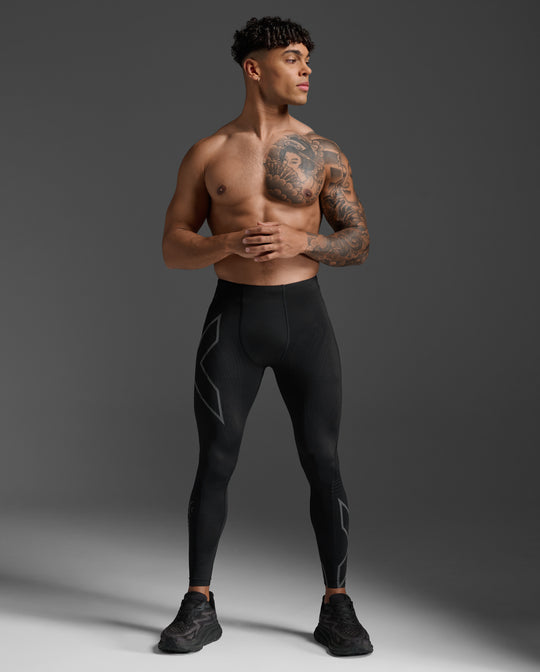
Your training deserves to count
Give your legs the one thing rest never could.
Shop the Light Speed Tightsor 4 payments of AUD$42.50 · Free standard shipping over AUD$80