
The Science of Performance: 5 Critical Benefits of Compression Shirts for Athletes
Your technical kit is either a performance multiplier or a wasted opportunity. While serious athletes meticulously select women's running tights to manage lower body fatigue and muscle vibration, the upper body is frequently left to suffer through postural collapse and energy-sapping oscillation. If you treat your shirt as a simple fabric layer rather than a precision mechanical intervention for the grind, you are conceding power and efficiency when it matters most.
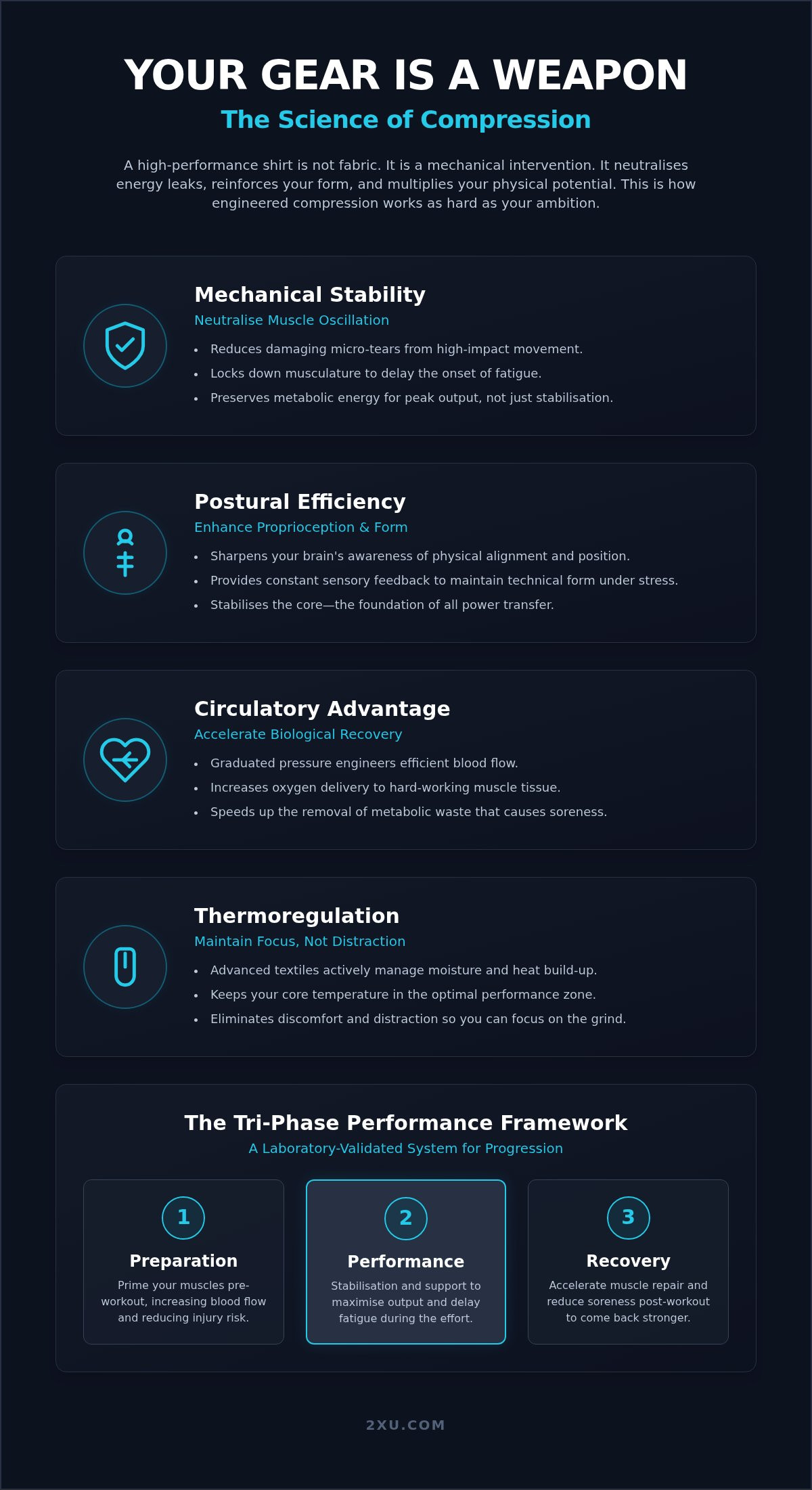
You know the physical toll of an endurance event; the burning in the shoulders and the loss of technical form are not just signs of fatigue, but failures in mechanical stability. We will demonstrate how engineered compression shirts use graduated pressure and targeted mapping to stabilise the torso and accelerate biological recovery. By reading this analysis, you will discover the five critical benefits of compression technology, from improved proprioception to reduced post-workout soreness. This is the science of how your gear works as hard as your ambition to multiply your physical potential.
Key Takeaways
- Neutralise muscle oscillation and prevent micro-tears using mechanical support systems engineered to stabilise your upper body musculature.
- Maintain postural integrity by pairing your women's running tights with compression tops that enhance proprioception and technical form during the grind.
- Optimise circulatory efficiency through graduated pressure, accelerating metabolic waste removal and increasing oxygen delivery to active tissues.
- Regulate core temperature with technical textiles that manage moisture effectively, ensuring your focus remains on performance rather than distraction.
- Implement a laboratory-validated tripartite framework to systematically manage your progression through preparation, performance, and recovery.
Mechanical Stability: Reducing Muscle Oscillation and Micro-tears
Elite performance is built on the elimination of inefficiency. While most athletes focus on the power generated by their legs and the quality of their women's running tights, they often ignore the energy leak occurring in the upper body. A high-performance Compression garment is not just a tight layer of clothing; it's a sophisticated mechanical support system designed to lock down the musculature of the chest, back, and arms. By providing this external framework, compression gear reduces the physical toll of high-impact training and preserves your capacity for work.
Every time your foot strikes the pavement or you execute an explosive movement, a shockwave ripples through your soft tissue. This phenomenon is known as muscle oscillation. These unnecessary vibrations cause micro-tears in the muscle fibres, leading to structural damage that triggers the inflammatory response. When you stabilise the torso and arms with engineered tension, you significantly decrease this internal trauma. Reduced vibration equals a delayed onset of muscle fatigue, allowing you to maintain peak output for longer durations during high-intensity sessions.
It's vital to distinguish between a standard tight shirt and engineered graduated compression. A basic base layer is simply a small garment that feels restrictive. In contrast, 2XU technology uses precise, laboratory-validated pressure mapping to provide targeted support where it's needed most. This isn't about looking fit; it's about mechanical intervention that protects your physical assets during the grind.
The Link Between Vibration and Energy Leakage
Unsupported muscles are inefficient. When your pectoral and deltoid muscles are left to oscillate freely during a run, your body must expend metabolic energy simply to stabilise that tissue and maintain postural integrity. This is energy that should be directed toward propulsion and technical execution. A compression shirt acts as an external cage for the torso, providing the structural reinforcement your body needs to remain compact and powerful.
Muscle oscillation is a primary cause of inefficient energy expenditure that prematurely drains your glycogen stores and compromises your endurance. By dampening these vibrations, you ensure that every ounce of effort is translated into forward momentum rather than being lost to internal friction.
Protecting the Upper Body During High-Impact Training
During endurance events or explosive training, the shoulders and pectorals endure constant repetitive stress. This stress often manifests as post-workout soreness and, if left unmanaged, can lead to long-term overuse injuries. Mechanical stability is your first line of defence. By wrapping the major muscle groups of the upper body in high-performance technical textiles, you provide a level of protection that standard apparel cannot match.
Standard base layers lack the graduated tension required to actually influence muscle behaviour. They might wick sweat, but they don't provide the compressive force necessary to hold the muscle in place. Real compression gear is designed with specific tensile strengths that move with the athlete while maintaining a firm grip on the underlying anatomy. This ensures you can push through the most demanding phases of your programme without sacrificing the structural health of your upper body.
Postural Efficiency and Enhanced Proprioception
An elite athlete understands that the torso is not just a passenger; it is the foundation of all power transfer. Whether you're sprinting, lifting, or maintaining a steady pace, your core serves as the anchor for every movement. When this foundation weakens, your efficiency evaporates. This is why proprioception, your body's innate ability to sense its position and movement in space, is a critical variable in your performance equation. By wrapping the torso in a high-performance technical textile, you provide your brain with constant sensory feedback that sharpens your awareness of your physical alignment.
Research from the University of Connecticut confirms that this level of support reduces the oscillatory movement of muscle, which directly translates to better control over your kinetic chain. Just as high-quality women's running tights stabilise your lower half to prevent energy leakage, an engineered compression shirt ensures your upper body remains a functional asset rather than a liability. This "second skin" feel isn't just about comfort; it's a direct line of communication between your muscles and your central nervous system.
Correcting Form Through Sensory Feedback
Fatigue is the primary enemy of technical form. As you push deeper into the grind, your shoulders naturally begin to slump and your core disengages, which increases the metabolic cost of your movement. Compression garments act as a silent, persistent coach. They provide immediate tactile alerts the moment your posture begins to fail. This is especially vital for long-distance runners who need to maintain an upright chest to facilitate efficient movement. For triathletes transitioning from the bike to the run, this feedback helps re-establish a powerful gait immediately, ensuring no time is wasted in the transition phase.
Optimising Respiratory Mechanics
There's a common misconception among amateur athletes that compression gear restricts breathing. The scientific reality is the opposite. By providing mechanical support to the core and abdominal wall, compression actually aids the functional movement of the diaphragm. It creates a stable platform that allows for more effective lung expansion and better oxygen uptake during endurance events. You aren't just wearing a shirt; you're equipping yourself with a tool that helps you breathe deeper and more consistently under pressure. Beyond the physiological benefits, the feeling of being "locked in" provides a psychological edge that prepares your mind for the intensity of high-output sessions.
To experience this level of structural support and technical awareness, explore our range of Training Apparel designed for elite output.
Circulatory Advantage: Oxygenation and Metabolic Waste Removal
The heart is an engine that requires a clear exhaust system to function at peak capacity. During high-intensity training, your muscles demand a constant supply of oxygen while simultaneously generating metabolic waste. While high-performance women's running tights are essential for preventing blood pooling in the lower extremities, upper body compression completes the circulatory loop. Graduated compression in the arms and torso applies specific pressure gradients, tightest at the extremities and decreasing toward the heart, to mechanically assist venous return. This ensures that deoxygenated blood, loaded with carbon dioxide and lactate, is recycled through the lungs and heart more efficiently.
By increasing the velocity of blood flow, you accelerate the delivery of fresh, oxygenated blood back to the working tissues. This isn't just a theoretical benefit; it's a biological multiplication of your output. When your muscles receive oxygen faster, they can sustain aerobic metabolism longer, delaying the transition to anaerobic states that cause the familiar "burn" of fatigue. Managing this internal chemistry is what separates those who fade from those who dominate the final stages of a session.
Accelerating the Recovery Timeline
The grind doesn't end when you leave the track. Recovery is a physiological process that requires active management, not just passive rest. Improved circulation through the use of compression shirts significantly reduces the severity of Delayed Onset Muscle Soreness (DOMS). By maintaining blood flow post-workout, you facilitate the rapid removal of metabolic by-products and reduce the inflammatory markers that lead to stiffness. Serious athletes treat their post-session compression as an essential recovery protocol, ensuring their body is prepared for the next high-output session.
The Role of Venous Return in Endurance
In endurance sports, heart rate efficiency is the difference between a podium finish and a mid-pack result. When your kit assists the venous return, your heart doesn't have to work as hard to pull blood back from the periphery. Applied external pressure reduces the diameter of the veins, which mathematically increases blood flow velocity and prevents the pooling of deoxygenated blood. This reduction in cardiac strain allows you to maintain a higher power output at a lower relative heart rate. Just as you rely on women's running tights to keep your legs fresh during a marathon, upper body compression ensures your entire cardiovascular system operates with maximum mechanical advantage.
Thermoregulation and Moisture Management in Technical Fabrics
Maintaining a stable core temperature is a non-negotiable requirement for elite output. While serious competitors often invest heavily in high-grade women's running tights to manage lower body heat, the torso's microclimate is just as critical to overall performance. When your body overheats, blood is diverted from the working muscles to the skin's surface for cooling, which creates a significant performance deficit. High-performance technical textiles are engineered to manage this thermal load by facilitating rapid moisture transfer. Unlike basic materials that trap sweat, these advanced fabrics use capillary action to pull moisture away from the skin and onto the outer surface of the garment. This ensures that evaporative cooling occurs at the fabric level rather than against the skin, preventing the heavy, water-logged feeling that compromises focus during the grind.
This cooling effect is vital during high-intensity sessions where metabolic heat production is at its peak. By keeping the skin dry, technical fabrics help the body maintain homeostatic balance, allowing you to push harder for longer without the risk of thermal fatigue. The precision fit of a compression shirt also ensures that there is no excess material to trap heat or create drag, making your movements as efficient as possible. Every detail in the textile engineering is designed to multiply your capacity for work by removing environmental distractions.
Engineering the Microclimate
Technical fabrics act as a dynamic interface between your body and the environment. In cold conditions, the tight fit and dense weave of the textile trap a thin layer of air against the skin to provide insulation without bulk. Conversely, in high-heat scenarios, the high breathability of the knit allows for maximum airflow to dissipate heat. This dual-purpose engineering prevents thermal distress, a state where the body's cooling mechanisms are overwhelmed, leading to a rapid decline in power and cognitive function. This level of environmental control is a fundamental requirement for athletes who refuse to let the weather dictate their results.
Comfort and Chafing Prevention for Endurance
Repetitive movement is the enemy of skin integrity. During a marathon or a long-distance triathlon, the thousands of arm swings and torso rotations lead to debilitating abrasions if your gear isn't engineered for the task. Flatlock seams are a critical feature of professional-grade compression, providing a low-profile finish that eliminates the friction points found in traditional stitched garments. This is why the precision fit of your upper body gear must match the quality of your women's running tights. A 360-degree stretch ensures unrestricted mobility, while the tight fit prevents the fabric-on-skin friction that causes painful abrasions. These high-performance textiles are built for durability, maintaining their tensile strength and moisture-wicking properties through the most punishing training programmes.
To ensure your gear can withstand the rigours of your training programme, shop our range of Athletic Sportswear built for unyielding performance.
The 2XU Advantage: Engineering the Multiplied Athlete
Success in elite sport is never accidental. It is the result of disciplined preparation, unyielding performance, and a scientific approach to recuperation. While many athletes understand the necessity of high-performance women's running tights to manage lower body fatigue, the 2XU advantage lies in providing a holistic mechanical solution for the entire body. Our compression technology is not designed for the casual gym-goer; it is engineered for the rigours of the grind. Every seam, fabric weight, and pressure gradient is validated through rigorous laboratory testing to ensure it meets the uncompromising standards of world-class triathletes and endurance runners.
We operate within a specific tripartite athletic framework: prepare, perform, and recover. This chronological approach ensures that your gear is working to multiply your output at every stage of your journey. An engineered compression shirt serves as the essential foundation of this kit, bridging the gap between your metabolic potential and your physical execution. By integrating advanced circulatory support with mechanical stability, we provide the tools necessary to push past previous mathematical limits of performance.
Human Multiplied: The 2XU Mission
The mission at 2XU is clear: to multiply human capability through technical excellence. We reject average standards because the athletes we serve refuse to accept them. Our gear is a physical manifestation of your ambition, designed for those who respect the discipline required to achieve breakthrough results. We don't rely on generalised claims; we trust in numbers, peer-reviewed validation, and the tangible feedback of elite performers. When you step into our technical textiles, you are making a commitment to your own potential. You are choosing gear that has been proven to reduce muscle damage and accelerate the biological processes of repair.
Selecting the Right Gear for Your Discipline
To maximise the efficacy of graduated compression, you must select the garment profile that aligns with your specific training demands. Sleeveless options provide maximum ventilation and unrestricted shoulder mobility for explosive gym sessions or high-heat environments. Short-sleeve and long-sleeve shirts offer greater surface area for circulatory support and mechanical stability across the major muscle groups of the arms. Sizing is the most critical variable. For the graduated compression profile to function as intended, the garment must provide a firm, consistent fit that mirrors your anatomy without restricting movement. A loose fit is a failure of the system. Ensure your upper body support matches the precision of your women's running tights to create a unified performance platform.
Multiply your performance with 2XU compression shirts and experience the scientific advantage of elite-grade engineering.
Master the Mechanics of Elite Performance
The evidence is clear: performance is a precise calculation of mechanical efficiency and biological recovery. While you likely already prioritise women's running tights to protect your lower body, leaving your upper body unsupported is a tactical oversight that leads to energy leakage. Engineered compression shirts provide the structural framework necessary to neutralise muscle oscillation and the circulatory support required to accelerate venous return. This is a laboratory-validated system designed to work as hard as you do during the most punishing phases of the grind.
2XU technology is trusted by elite athletes globally because it delivers tangible results through scientifically validated graduated compression and superior moisture management. Our technical textiles are built for maximum durability, ensuring they maintain their performance-multiplying properties through every session. Don't settle for average standards when you can equip yourself with gear that has been proven to enhance physical output and speed up the recovery timeline.
Multiply your performance with 2XU compression shirts and refuse to accept anything less than your absolute potential. The path to your best results is earned through discipline and the right equipment. Get to work.
Frequently Asked Questions
Do compression shirts actually improve performance during a workout?
Compression shirts improve performance by minimising muscle oscillation and preventing energy leakage during high-impact movements. By stabilising the upper body, these garments reduce the metabolic cost of maintaining posture, allowing more power to be directed into your athletic output. This mechanical intervention ensures that every movement is as efficient as possible, delaying the onset of fatigue during the grind.
Should I wear a compression shirt for recovery after training?
Wearing a compression shirt post-workout is a critical component of the recovery phase. The graduated pressure assists venous return and accelerates the removal of metabolic by-products like lactate. This process reduces muscle soreness and ensures you are biologically prepared for your next session. Elite athletes use this protocol to maintain a high training frequency without sacrificing structural integrity.
Will a compression shirt make it harder to breathe during intense cardio?
Engineered compression actually facilitates better respiratory mechanics by providing a stable platform for the diaphragm. It doesn't restrict lung expansion; instead, it supports the core and abdominal wall to ensure efficient breathing patterns during the most intense cardiovascular loads. You will feel locked in and supported, which often provides a psychological edge during high-output endurance events.
How tight should a compression shirt feel for it to be effective?
A compression shirt must provide a firm, "second skin" fit to be mechanically effective. It should feel significantly tighter than standard training apparel but must not restrict your range of motion. If the fabric is bunching or lacks a consistent grip on the musculature, the graduated pressure profile is compromised and the performance benefits will be negated.
Can I wear a compression shirt as a base layer under other athletic gear?
You can and should use compression shirts as a high-performance base layer. Just as elite athletes pair women's running tights with outer layers in cold conditions, an upper body compression layer provides thermal regulation and moisture management beneath your standard kit. This setup allows for maximum technical support without adding unnecessary bulk or restricting your mobility.
Do compression shirts help with posture and back support?
Compression garments significantly enhance postural awareness through increased proprioceptive feedback. The constant sensory input alerts your brain the moment your form begins to fail or your shoulders slump. This mechanical support is vital for maintaining an upright torso and preventing the technical collapse that often follows extreme fatigue during long-distance training.
How do I care for my technical compression gear to ensure longevity?
To preserve the tensile strength of technical textiles, always wash your gear in cold water on a gentle cycle. Avoid using fabric softeners or tumble dryers, as high heat and harsh chemicals degrade the elastane fibres responsible for the compression. Air drying in the shade is the only way to ensure the long-term mechanical integrity of your investment.
Are there specific benefits for triathletes using compression shirts?
Triathletes benefit from the mechanical stability provided during the critical transition from the bike to the run. The compression helps re-establish postural alignment immediately after dismounting, ensuring a more efficient gait. Much like high-grade women's running tights, these shirts contain the muscles against high-impact forces, reducing micro-tears and preserving your capacity for the final leg of the race.