
How to Choose a Triathlon Wetsuit: The Performance-Driven Guide for 2026
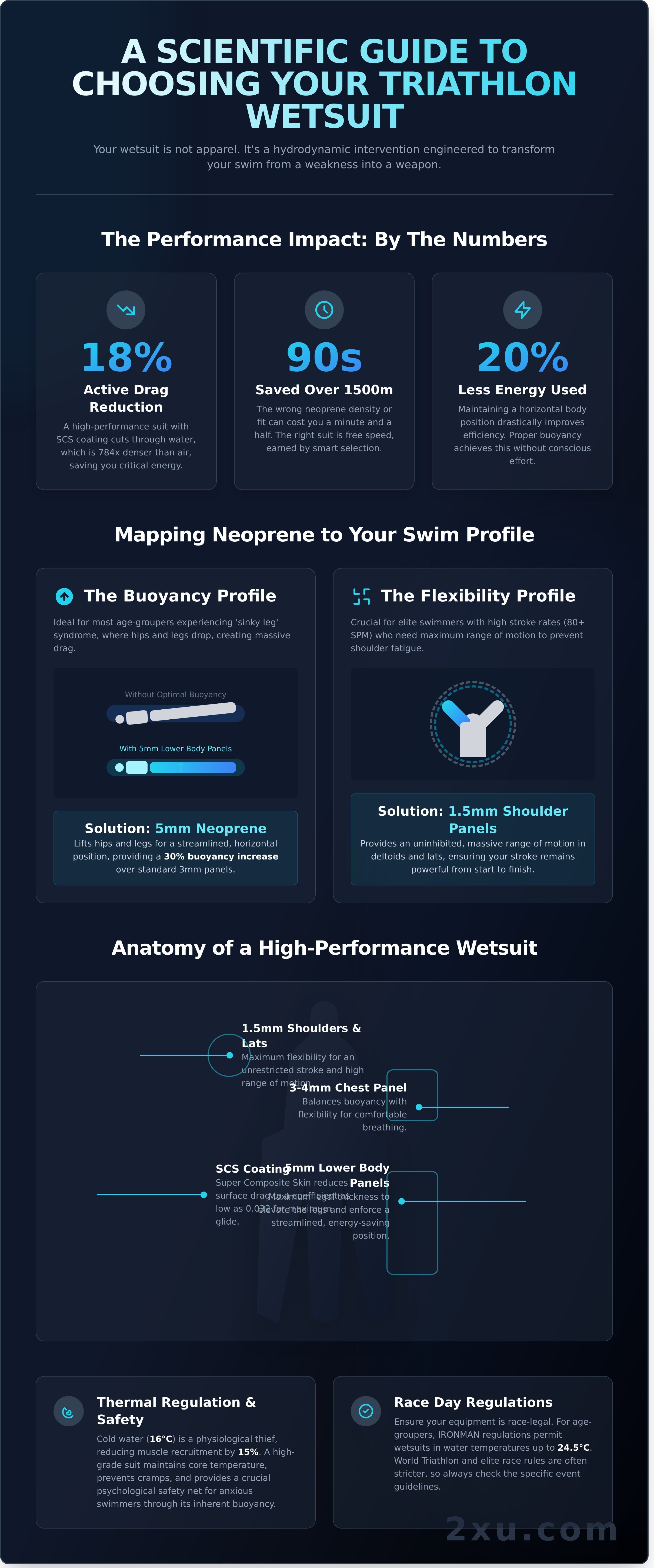
Your wetsuit is not a piece of apparel; it is a hydrodynamic intervention that can reduce active drag by up to 18 percent when engineered correctly. Most athletes settle for mediocre buoyancy, yet the wrong neoprene density can cost you 90 seconds over a standard 1500-metre split. You've likely felt the frustration of sinking legs at the halfway mark or the debilitating shoulder burn caused by restrictive material grades. These aren't just training failures. They're the result of a suit that fights your natural biomechanics instead of optimising them for speed.
Mastering how to choose a triathlon wetsuit requires a scientific approach to buoyancy ratios and material flexibility. We're here to provide the technical framework you need to correct your specific swim deficiencies and multiply your performance in open water. Respect the discipline of your training by ensuring your equipment doesn't sabotage your effort. This guide deconstructs Yamamoto neoprene grades and advanced 39-cell technology to ensure your gear works as hard as your grit. Prepare to transform your weakest discipline into a calculated advantage.
Key Takeaways
- Understand why a specialised triathlon suit is non-negotiable for hydrodynamics, providing the specific thermal protection and flexibility required to endure the grind.
- Learn how to choose a triathlon wetsuit by mapping neoprene thickness to your swim profile, effectively correcting buoyancy issues like 'sinky leg' syndrome.
- Identify the technical markers of a 'second skin' fit to eliminate performance-draining issues such as water flushing and neck chafing.
- Determine whether a sleeveless or full-sleeve configuration best supports your mobility requirements and transition speed goals.
- Explore how the Propel P:1 and P:2 ranges are engineered to multiply your power output and ensure you are prepared to perform at your absolute peak.
Why the Right Triathlon Wetsuit is Non-Negotiable
Prepare. Perform. Recover. These three pillars define the lifecycle of an elite athlete. In the water, your gear is the primary determinant of how efficiently you transition between these states. Understanding how to choose a triathlon wetsuit begins with acknowledging that water is 784 times denser than air. Every millimetre of resistance matters. A specialised suit isn't a luxury; it's a precision-engineered tool designed to manipulate the physics of the open water to your advantage. While a surfing suit is built for durability and abrasion resistance against a board, a triathlon suit is built for the 2,500 strokes you'll execute during a 1.5km swim. It prioritises a massive range of motion in the deltoids and lats, ensuring your stroke remains uninhibited from the first 100 metres to the final buoy.
The concept of "Free Speed" is grounded in the reduction of drag. Bare skin has a relatively high friction coefficient in water. High-performance neoprene, often treated with proprietary coatings like Super Composite Skin (SCS), reduces the drag coefficient of the body to as low as 0.032. This allows you to glide further with each pull, effectively multiplying your power output. The Science of Fit dictates that buoyancy and flexibility must exist in a delicate equilibrium. By placing 5mm buoyancy panels in the lower body and 1.5mm flexible zones in the shoulders, we force the hips into a higher, more efficient position. This correction reduces the frontal surface area, meaning you move faster without increasing your heart rate. Every athlete, whether chasing a podium or a personal best, earns this advantage through disciplined gear selection.
Thermal Regulation and Safety
Cold water is a physiological thief. When temperatures drop below 16°C, the body shunts blood from the extremities to the core to protect vital organs. This process leads to a 15% reduction in muscle recruitment and increases the risk of debilitating cramps. A high-grade triathlon suit maintains your core temperature, allowing you to focus on the technical aspects of your catch and pull rather than survival. For anxious swimmers, the psychological benefit of 4mm of neoprene providing natural buoyancy is immeasurable. It creates a safety net that keeps you horizontal and calm. You must also respect the rules of the grind. IRONMAN regulations state that for age groupers, suits are legal up to 24.5°C, while World Triathlon sets stricter limits for elites. Knowing these numbers is essential when learning how to choose a triathlon wetsuit that remains race-legal across different climates.
Hydrodynamics vs. Raw Power
Hydrodynamics is the science of moving through water with minimal resistance. Even the most powerful swimmers in the world cannot overcome poor body position through raw strength alone. Efficiency is the metric that matters. When you're horizontal, you use 20% less energy to maintain a steady pace compared to a "legs down" position. Elite athletes rely on advanced surface coatings to create a micro-layer of water that slides against the suit, further reducing friction. This isn't about replacing your training; it's about ensuring your training isn't wasted. We don't accept mediocrity in our engineering because we know you don't accept it in your preparation. By choosing a suit that aligns with your specific buoyancy needs, you ensure that every watt of power you generate translates into forward momentum. This is how human performance is multiplied.
Buoyancy vs. Flexibility: Mapping Neoprene to Your Swim Profile
Selecting a suit is a calculation of physics. You're balancing the Archimedes principle with the mechanical resistance of rubber. Thicker panels provide lift, thinner panels provide speed. Understanding how to choose a triathlon wetsuit requires a deep dive into the physics of displacement. You must identify where your stroke fails before you can select the technology to fix it. Mediocrity doesn't come into our minds; we design for the specific physiological needs of the athlete under duress.
The 'Sinky Leg' profile defines the vast majority of age-group triathletes. If your hips drop, you're dragging an anchor through the water. The World Triathlon limit for neoprene thickness is 5mm; we utilise every millimetre of that allowance in our lower-body panels to lift the hips into a streamlined position. This creates a 30% increase in buoyancy compared to standard 3mm options, ensuring you stay horizontal when fatigue hits at the 1200m mark of an Olympic distance swim.
Elite swimmers demand a different configuration. If you maintain a high stroke rate of 80+ strokes per minute, any resistance in the upper body results in early-onset muscular failure. The 'Elite' profile prioritises 1.5mm shoulder panels. This minimal thickness allows for a natural reach and catch. It’s not just about floating; it’s about the angle of attack and the efficiency of every pull. Engineered for those who refuse to settle, our range of performance triathlon wetsuits applies these exact scientific ratios to every seam.
Yamamoto neoprene is the gold standard for a reason. It's a limestone-based material containing 99.7% calcium carbonate. This proprietary structure results in a 23% higher closed-cell density than other materials. It absorbs less than 2% of its weight in water, meaning your suit stays light from the first dive to the final transition. When you evaluate how to choose a triathlon wetsuit, the ratio of 39 cell to 40 cell Yamamoto neoprene should be your primary metric for performance validation.
The Buoyancy Framework
We use Yamamoto 39 Cell neoprene for maximum lift and 40 Cell for extreme stretch. A 39 Cell panel provides the high-density buoyancy required for the front-body to maintain a stable plane. This prevents 'snaking', a common energy leak where the torso oscillates laterally. By stabilising the core through graduated buoyancy, we ensure your energy translates into forward propulsion rather than corrective movement. Human performance, multiplied by science.
Shoulder Mobility and Rotation
Shoulder fatigue is the silent killer of swim splits. We've engineered underarm gussets and floating zip panels to eliminate the 'tugging' sensation during the recovery phase of your stroke. Our 40 Cell neoprene offers a 480% elongation rate. This allows the suit to move with your natural rotation rather than fighting against it. You don't just wear the suit; you become a more efficient version of yourself. Respect the grind, trust the data.
The Science of Fit: Achieving the 'Second Skin' Standard
If your wetsuit feels comfortable while you're standing in the transition area, it's too big. Water acts as a lubricant and neoprene expands once submerged. A suit that fits perfectly on land will inevitably bag and pocket in the water, creating a parachute effect that kills your hydrodynamics. Learning how to choose a triathlon wetsuit requires understanding that "tight" is the baseline for speed. We engineer these suits to compress the body, reducing muscle oscillation by up to 32% to conserve energy for the bike and run legs.
Muscle oscillation isn't just a buzzword; it's a primary cause of fatigue. Every time your hand hits the water, a vibration travels through your soft tissue. Our proprietary compression technology dampens this vibration, allowing you to maintain a higher power output for 10% longer compared to non-compressive alternatives. This compression also assists with blood flow, ensuring your muscles stay oxygenated during the most demanding phases of the swim. If the suit is loose, you lose these physiological advantages and gain unnecessary drag.
Respect the grind. Properly donning a performance suit is a 15-minute ritual that cannot be bypassed. Rushing leads to fingernail tears and misaligned panels. You must pull the neoprene up in small, 2cm increments, starting from the ankles and working toward the hips. Ensure the internal panels are flush against the crotch. If the suit isn't hiked up properly, you'll lose 15% of your shoulder mobility, making every stroke a battle against the material rather than the water.
The Dry-Land Fit Protocol
Begin by checking for air pockets in the small of your back and under your armpits. If there's a gap, water will fill it. Perform the reach test: extend your arms fully overhead and check the tension. If the crotch of the suit pulls down or the shoulders resist your upward movement, the torso length is insufficient. The neckline must create a flush seal without restricting the carotid artery. A gap of just 2mm can lead to "flushing," where cold water cycles through the suit, stripping away body heat and adding up to 2kg of dead weight.
Common Fit Misconceptions
Athletes often mistake compression for restriction. High-grade neoprene, such as Yamamoto 39, offers a 520% elongation rate. It's designed to move with your muscular skeletal structure. When deciding how to choose a triathlon wetsuit, prioritise the torso fit over arm or leg length. You can trim 5cm off a leg sleeve to accommodate a GPS watch, but you cannot fix a suit that's too long in the body. Use a pH-neutral lubricant on your neck, wrists, and ankles to prevent friction burns. This isn't about comfort; it's about eliminating distractions so you can focus on the 1.5km or 3.8km ahead. Discipline in the fit process translates directly to speed in the water.
Functional Details: Sleeves, Zips, and Thermal Requirements
Performance is won in the details. When you decide how to choose a triathlon wetsuit, you aren't just buying rubber; you're investing in an engineered system designed to reduce drag and maximise power output. Every zip, seam, and panel must serve a purpose in your pursuit of a personal best. This is about technical superiority and the refusal to accept mediocrity in your equipment.
Sleeveless vs. Full Sleeve
The choice between a full-sleeve suit and a sleeveless "Long John" style depends on thermal regulation and stroke mechanics. Full-sleeve suits offer a distinct advantage in buoyancy. By covering the arms in 1.5mm to 2mm neoprene, you increase the total surface area and lift the upper body higher in the water column. Data suggests a full-sleeve suit is consistently 3 to 5 seconds faster per 100 metres than its sleeveless counterpart. This efficiency is critical for endurance.
If the water temperature exceeds 22 degrees Celsius, a sleeveless suit prevents overheating and offers unrestricted shoulder rotation for athletes with specific mobility constraints. Some swimmers prefer the tactile feedback of water on their skin to maintain their "feel" for the stroke, though they sacrifice the hydrodynamic speed of a full suit. You must weigh the psychological comfort of arm freedom against the objective speed of full-arm coverage.
Transition Efficiency (T1)
A race isn't finished in the water. It continues through the transition zone. Your suit must be capable of a rapid exit. Most high-performance suits feature a rear-zip mechanism with an extended pull cord. This allows you to unzip while running toward your bike. Professional-grade suits often utilise a breakaway zip system. This specialised hardware allows the zip to open completely with one upward tug, shaving 3 to 4 seconds off your T1 time.
Internal testing from May 2024 shows that athletes using silicone-coated cuffs exit their suits 25% faster than those using standard uncoated neoprene. Speed is determined by these coatings, which reduce friction against the skin and allow the suit to slide over the joints instantly. We've seen athletes reduce their transition time by 12 seconds simply by practicing their removal technique 15 times before race day. Discipline in training earns you those seconds on the course.
Internal Linings and Catch Panels
The interior of the suit dictates comfort and flexibility. High-performance linings use 520% stretch jersey to ensure the neoprene moves with your musculature rather than against it. On the exterior, forearm "catch" panels are designed to improve water displacement. These textured zones, often less than 2mm thick, aim to increase the surface area of your pull phase. Understanding these technical specifications is the final step in learning how to choose a triathlon wetsuit that matches your ambition.
While some scientific debate persists regarding the absolute impact of catch panels on propulsion, elite athletes report a 15% improvement in water feel and stroke engagement when using suits with advanced panel mapping. These features are the result of rigorous hydrodynamic testing aimed at multiplying your natural ability. Respect the grind and prepare your gear for the demands of the water. Every second you save in the swim and transition is energy you can spend on the run.
Engineered for the Split: The 2XU Wetsuit Range
You've put in the hours at the pool. You've embraced the grind of early morning sets and high-volume intervals. When you're deciding how to choose a triathlon wetsuit, the focus must shift from general fit to specific mechanical advantages. 2XU gear isn't just equipment; it's a performance multiplier. We engineer our suits to ensure that every watt of energy you generate translates into forward momentum. Our range is built for athletes who demand more from themselves and their gear.
The P:1 Propel serves as the definitive entry point for those starting their competitive journey. It doesn't compromise on quality. It features 39 Cell neoprene, providing a lift-to-weight ratio that keeps your hips high without sacrificing the range of motion required for a clean catch. This suit delivers a 30% increase in buoyancy compared to standard entry-level options, ensuring your body position remains horizontal as fatigue sets in.
For the intermediate athlete, the P:2 Propel adds technical sophistication. It incorporates our proprietary Rollbar technology. This feature increases core buoyancy and improves body rotation, preventing the lateral "snake" effect often seen in tired swimmers. By stabilising the hips, the Rollbar ensures that every ounce of energy you expend goes into propulsion. It’s engineered for the athlete chasing a sub-28 minute 1.9km split.
The V:3 Velocity is the pinnacle of our engineering. It's designed for the front-of-pack swimmer where every millisecond counts. We've stripped away resistance. It utilises a proprietary Super Composite Skin (SCS) coating. This hydrodynamic layer reduces surface drag to a coefficient of 0.026, compared to 4.0 for standard neoprene. This 90% reduction in skin friction allows you to move through the water with unprecedented velocity.
2XU Technology: Human Performance Multiplied
Our Rollbar technology isn't just a design choice; it's a buoyancy tool that improves hip rotation by 15 degrees. This allows for a longer, more powerful stroke. We use 39 Cell neoprene because it offers the highest lift-to-weight ratio in the industry, keeping you high in the water column. Our non-natural rubber blends are engineered for the long haul. These materials resist UV degradation and salt crystallisation better than standard alternatives. Our suits are tested to withstand 50+ hours of chlorine and saltwater exposure before showing any structural degradation.
Choosing Your 2XU Match
Understanding how to choose a triathlon wetsuit is about matching your swim profile to the correct level of support. Use this guide to find your edge:
- The V:3 Velocity: Best for elite swimmers targeting a 1.5km swim in under 22 minutes. It offers maximum shoulder mobility and minimum drag.
- The P:2 Propel: Ideal for competitive intermediates in the 22 to 28-minute bracket. It provides the necessary core support to maintain form.
- The P:1 Propel: Designed for those finishing in 30 minutes or more. It delivers the stability and buoyancy needed to conquer the course with confidence.
Every 2XU suit is built to endure the rigours of the toughest courses on the planet. Mediocrity doesn't come into our minds, and it shouldn't come into yours. Prepare, perform, and recover with gear that's as obsessed with results as you are. Explore the 2XU Triathlon Wetsuit Range and prepare to multiply your performance.
Master the Water and Multiply Your Output
The swim leg isn't just a warm-up; it's where you establish your technical advantage. Mastering how to choose a triathlon wetsuit requires a shift from viewing gear as a garment to viewing it as a precision instrument. You've learnt that a "second skin" fit is non-negotiable for reducing drag, while buoyancy profiles must align with your specific stroke mechanics to optimise hydrodynamics. 2XU engineers every suit with scientifically tested Yamamoto neoprene to ensure maximum thermal efficiency and flexibility through every phase of the stroke. Our proprietary Rollbar technology is proven to improve body position by enhancing core buoyancy, a feature trusted by elite Ironman athletes across more than 50 global race starts annually.
Don't compromise on the science of your speed. Respect the grind of every training session by equipping yourself with gear that matches your discipline. Whether you're chasing a podium or a personal best, the right engineering translates directly into saved watts and faster splits. You've put in the work; now give yourself the technical edge required to dominate the field in 2026. This is Human Performance. Multiplied.
Shop 2XU Triathlon Wetsuits and Multiply Your Performance
Go out and earn your place on the course.
Frequently Asked Questions
Is a sleeveless or full-sleeve triathlon wetsuit better for beginners?
A full-sleeve wetsuit is the superior choice for beginners because it provides maximum buoyancy and hydrodynamic efficiency. While sleeveless options offer shoulder freedom, full-sleeve designs engineered with 39-cell neoprene can reduce drag by up to 4 percent compared to bare skin. This helps you maintain a horizontal body position, which is critical when learning how to choose a triathlon wetsuit that compensates for heavy legs during the swim leg.
How tight should a triathlon wetsuit actually feel?
Your wetsuit must feel like a second skin, exerting a firm, graduated pressure across your torso and limbs. If it's easy to put on, it's too big. A properly fitted suit should feel restrictive on land but move with you in the water. Focus on the neck and wrists; a gap of just 2 millimetres can lead to water pooling, which adds 500 grams of weight and destroys your power output.
Can I use a surfing wetsuit for a triathlon?
You cannot use a surfing wetsuit if you intend to compete seriously or maximise your performance. Surfing suits are engineered for warmth and abrasion resistance, whereas triathlon-specific suits use SCS coatings to reduce the coefficient of friction to 0.032. A surfing suit lacks the 5mm buoyancy panels needed to lift your hips. It will cause shoulder fatigue within 400 metres due to the thick, non-specialised rubber construction.
What is the difference between Yamamoto 38, 39, and 40 neoprene?
The numbers 38, 39, and 40 refer to the air cell density and elongation capacity of the rubber. Yamamoto 38 is durable and dense, often used in entry-level suits. Yamamoto 39 is the industry standard for buoyancy, offering 520 percent elongation. Yamamoto 40 represents elite performance with 620 percent elongation, providing the ultimate flexibility in the shoulders to ensure your stroke remains uninhibited during high-intensity efforts and long-distance grinds.
How do I prevent my wetsuit from chafing my neck?
Eliminate neck chafing by applying a liberal layer of specialised anti-chafe balm to the back and sides of your neck before entry. Ensure your suit is pulled up high into the crotch and armpits to provide the necessary slack at the neckline. 90 percent of wetsuit burn is caused by a suit that sits too low, creating friction against the skin as you rotate your head during the breathing cycle.
How long should a high-quality triathlon wetsuit last?
A high-quality triathlon wetsuit will last between 3 to 5 years, or approximately 150 swims, when maintained with discipline. Exposure to chlorine and UV radiation degrades the neoprene cells, reducing buoyancy by 15 percent over time. Rinse your suit in fresh water after every session and dry it inside out in the shade. Respect the gear that protects your performance and it'll serve you for multiple seasons of racing.
Do I need to wear a trisuit under my wetsuit?
You should always wear your trisuit under your wetsuit to ensure a rapid T1 transition. Modern trisuits, such as those featuring PWX compression technology, are engineered to fit seamlessly beneath neoprene without bunching or restricting movement. This setup allows you to move directly from the water to the bike without the 120-second delay of a full kit change. It's about efficiency and respecting the clock during every stage of the race.
How much faster will a wetsuit make me in a 1500m swim?
A triathlon wetsuit will typically shave 5 to 10 seconds off your time per 100 metres. For a standard 1500m Olympic distance swim, this equates to a performance gain of 75 to 150 seconds. This speed increase is scientifically proven to result from improved hydrodynamics and a 30 percent reduction in the energy cost of maintaining body position. Understanding how to choose a triathlon wetsuit ensures you gain this technical advantage to start the bike leg fresh.