
Engineered for Victory: The Definitive Guide to Triathlon Shorts
Victory in a triathlon is a war of attrition, won by inches and seconds. Yet many athletes compromise their performance before the race even begins, handicapped by equipment that creates drag, chafes, and retains water. Mediocrity in gear selection leads to mediocre results. A standard cycling short will fail you in the water and on the run. The solution is not just apparel; it is scientifically engineered equipment. The right pair of triathlon shorts is a critical component of your performance arsenal, designed to function as a second skin across all three disciplines.
This is your definitive guide to understanding that engineering. We will deconstruct the advanced material science, from hydrophobic fabric coatings that shed water for a faster swim-to-bike transition, to the graduated compression profiles that reduce muscle oscillation and delay fatigue. You will learn to differentiate between chamois technology optimized for long-course endurance versus short-course speed. The objective is clear: to arm you with the technical knowledge required to select the ideal triathlon shorts, eliminating discomfort and unlocking new levels of speed. Prepare to make your most informed and impactful gear decision yet.
Key Takeaways
- Understand why elite triathlon shorts are engineered as multi-discipline equipment, not just apparel, to maximize power and efficiency.
- Discover the critical material science and biomechanical features that reduce drag, support muscles, and increase speed.
- Learn a race-proven protocol for selecting the optimal pair based on distance, conditions, and your specific performance goals.
- Gain tactical clarity on the triathlon shorts vs. trisuit debate to make the superior choice for your next competition.
Deconstructing the Triathlon Short: More Than Just Apparel
Triathlon shorts are not merely apparel; they are a piece of scientifically engineered equipment designed for a single, uncompromising purpose: multi-sport performance. Unlike dedicated cycling or running shorts, which are optimized for a single discipline, a tri short is meticulously developed to excel across all three stages of the event. To fully grasp its advanced design, one must first understand what is a triathlon-a continuous, multi-stage competition demanding peak performance without interruption. This requires apparel that functions as a second skin, moving from water to land seamlessly.
The core objective is absolute race-day efficiency. Every second saved in transition is a second gained on the course. Therefore, these shorts are engineered to eliminate the need for changing, providing a strategic advantage by minimizing friction, reducing hydrodynamic and aerodynamic drag, and delivering uncompromising comfort from the start line to the finish.
Triathlon Shorts vs. Cycling Shorts: The Critical Differences
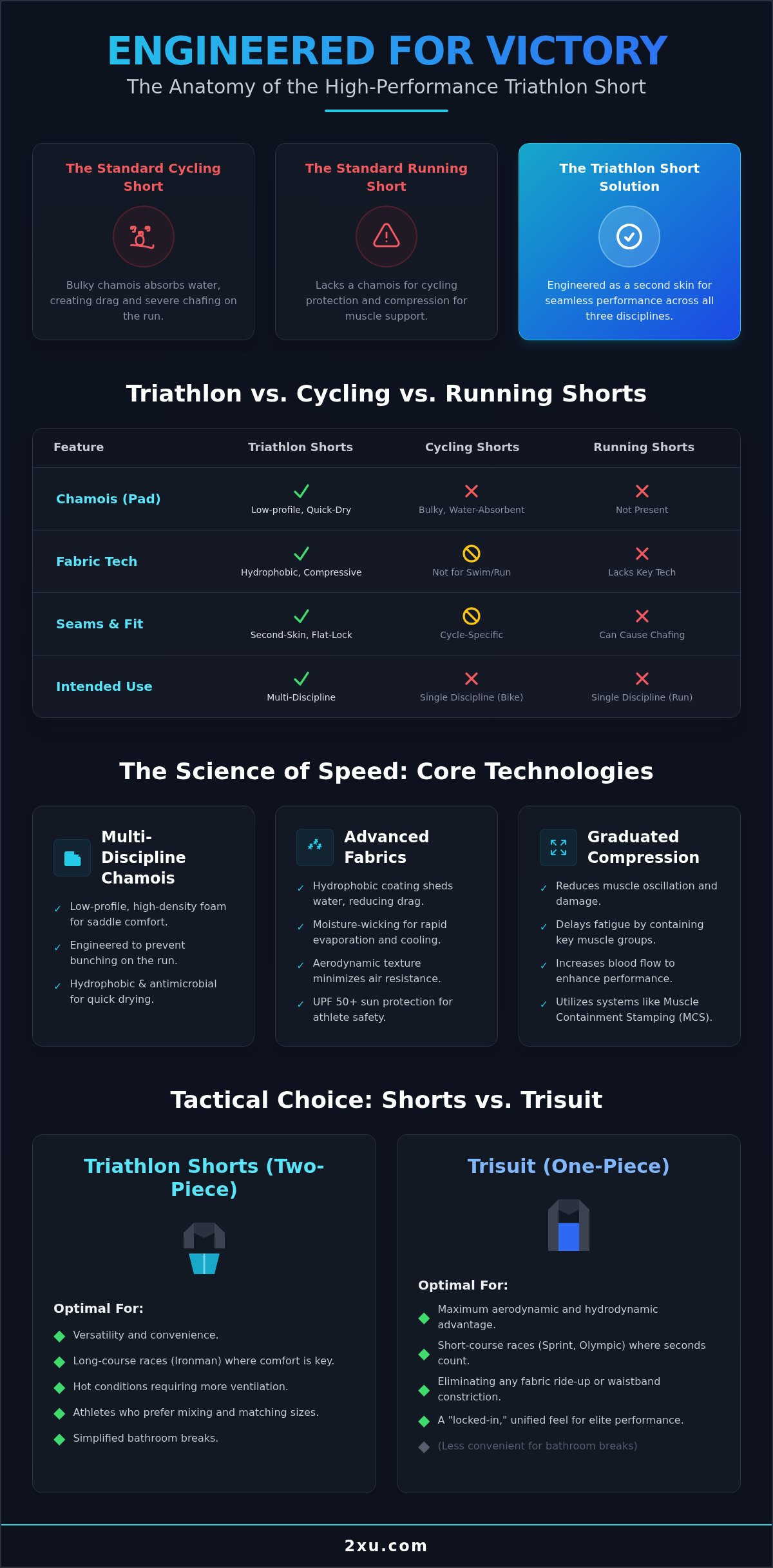
The distinctions between triathlon shorts and their cycling-specific counterparts are stark and performance-critical. A bulky, moisture-absorbing cycling chamois becomes a significant liability on the run. In contrast, tri shorts are defined by key technological superiorities:
- Chamois (Pad): A low-profile, high-density foam pad provides essential saddle protection without impeding stride on the run. It is engineered to be quick-drying and anti-bacterial.
- Fabric: Advanced hydrophobic and compressive materials shed water instantly after the swim and stabilize key muscle groups to reduce oscillation and delay fatigue.
- Seams: Fewer, strategically placed, and flat-locked seams are utilized to eliminate the potential for chafing during the repetitive, high-impact motion of the run.
- Fit: A more athletic, second-skin fit delivers superior muscle support and enhanced aerodynamics across all three disciplines.
Triathlon Shorts vs. Running Shorts: Why Runners Need More
A standard running short is fundamentally ill-equipped for the unique demands of a triathlon. While built for movement, it lacks the specialized features required for the swim and bike legs. The upgrade to a tri short is non-negotiable for any serious competitor, providing critical advantages like a specialized chamois for cycling protection, advanced compression to enhance power output, silicone leg grippers to prevent fabric from riding up on the bike, and quick-drying materials that won't become waterlogged and heavy after the swim.
The Science of Speed: Key Technologies Engineered into Every Pair
Elite performance apparel is not merely fabric; it is a scientifically engineered system designed to optimize the entire athletic cycle: Prepare, Perform, and Recover. The technical components integrated into advanced triathlon shorts are a testament to meticulous research in material science, biomechanics, and aerodynamics. These technologies are what separate race-day equipment from basic training gear, creating a tangible competitive advantage.
The Chamois: Engineered for Multi-Discipline Comfort
The chamois in a triathlon short is a marvel of multi-discipline engineering. Unlike the thick, dense pads found in dedicated cycling shorts, it features a lower-profile, high-density foam construction. This design provides critical pressure relief during the bike leg without creating friction or bunching during the run. Its advanced hydrophobic and antimicrobial properties ensure it sheds water rapidly post-swim, preventing chafing and maintaining hygiene over long-course events.
Advanced Fabrics: Hydrodynamics, Aerodynamics, and Cooling
The fabric itself is an active performance tool. Engineered with hydrophobic coatings, it repels water to reduce hydrodynamic drag in the swim. On land, its moisture-wicking capabilities are paramount, pulling sweat from the skin for rapid evaporation and superior temperature regulation. The evolution of smart garment technology has led to the development of aerodynamically textured fabrics that minimize air resistance on the bike. Essential features like chlorine resistance and UPF 50+ sun protection ensure garment durability and athlete safety.
The Role of Graduated Compression
Graduated compression is a cornerstone of high-performance triathlon shorts. By applying precise, graduated pressure to key muscle groups, it enhances performance and accelerates recovery. Proprietary systems like Muscle Containment Stamping (MCS) offer a detailed map of support, drastically reducing muscle oscillation and damage during high-impact activity. This containment minimizes fatigue and lowers the risk of strain. Furthermore, compression is scientifically proven to increase blood flow, improving oxygenation to working muscles and clearing metabolic waste for a faster, more efficient recovery.
Selection Protocol: How to Choose the Right Triathlon Shorts
Selecting your race-day apparel is not a matter of preference; it is a calculated decision based on physiology, distance, and performance targets. Your equipment must be engineered to multiply your output. This protocol ensures your choice is scientifically sound, empowering you to analyze your needs with expert precision.
Engineered for the Distance
The demands placed on your body and equipment escalate with distance. Your selection must reflect this reality. Each race format requires a specific combination of features to optimize performance and mitigate fatigue.
- Sprint/Olympic: Prioritize hydrodynamics and rapid transitions. A minimalist, fast-drying chamois is critical for a seamless swim-to-bike and uninhibited run. Aerodynamic efficiency is paramount.
- Half-Ironman (70.3): This distance demands a balanced solution. The chamois must offer substantial protection for 56 miles in the saddle but remain low-profile enough for an aggressive half-marathon. Integrated compression and accessible nutrition storage become vital.
- Full Ironman (140.6): Endurance and comfort are non-negotiable. A multi-density, anatomically mapped chamois is required to combat saddle fatigue over 112 miles. Generous, secure storage is mandatory to execute a complex nutrition strategy.
Fit as a Performance Multiplier
Your triathlon shorts must function as a second skin. A precision fit is crucial for activating graduated compression, which is scientifically proven to reduce muscle oscillation and delay fatigue. It also eliminates fabric bunching and aerodynamic drag. Measure your waist and inseam against the manufacturer's chart-do not estimate. Advanced silicone leg grippers are essential to lock the hem in place, ensuring consistent coverage and muscle support. A loose fit creates drag; a tight fit restricts blood flow. Precision is the only acceptable standard.
Advanced Features for Tactical Advantage
Beyond the core fabric and fit, superior design features provide a distinct competitive edge. Look for flatlock seams to create a chafe-free interface with your skin, a critical detail for endurance events. Waistband construction also matters; a flat-front design with an internal drawcord offers superior comfort in the aero position while ensuring a secure fit on the run. Finally, analyze storage: strategically placed rear or side pockets must offer secure, low-profile access to nutrition without disrupting your form. These details are what separate elite gear from the competition. Explore 2XU's scientifically engineered collection to see these principles in action.
Triathlon Shorts vs. Trisuits: Making the Right Choice
Once an athlete has moved beyond standard cycling shorts, the next critical gear decision is between a two-piece system-comprising triathlon shorts and a separate top-or an integrated one-piece trisuit. This is not a choice of preference, but a strategic decision that directly impacts aerodynamics, comfort, and logistical efficiency on race day. Understanding the distinct performance advantages and limitations of each system is essential for optimizing your output.
The Case for Triathlon Shorts (Two-Piece System)
The two-piece configuration offers unparalleled versatility. Athletes can mix and match tops and bottoms to adapt to variable weather conditions or specific race demands. This system is engineered for a superior fit for athletes with different torso and leg proportions and offers a significant logistical advantage for faster, less cumbersome bathroom breaks mid-race.
- Pro: Maximum versatility for training and racing in varied climates.
- Pro: Unmatched speed and efficiency for mid-race pit stops.
- Pro: Allows for a customized fit for non-standard body types.
- Con: Potential for aerodynamic drag from a top riding up or fabric bunching at the waist.
The Case for a Trisuit (One-Piece System)
For the athlete obsessed with shaving seconds, the trisuit is the definitive choice. Its seamless, single-piece construction creates a second-skin fit that minimizes drag and eliminates any potential for fabric movement. By removing the waistband, it also eradicates a common pressure point, ensuring consistent comfort and muscle support from the first swim stroke to the final stride.
- Pro: Superior aerodynamic profile for measurable time savings.
- Pro: Consistent, uniform compression and comfort with no waistband pressure.
- Con: Less versatile for training and can be more restrictive.
- Con: Inherently slower and more difficult for necessary bathroom breaks.
When to Use Each: A Recommendation Framework
The optimal choice is dictated by your objective. Triathlon shorts are a powerful tool for long training blocks and for athletes who prioritize a highly customized fit or race longer distances where pit stops are a certainty. The trisuit, however, remains the undisputed champion for race day, particularly in shorter-course events where every watt saved from aerodynamic drag translates to a faster finish. We recommend new athletes test both systems to determine which best supports their unique physiology and performance goals. Your gear should be a weapon, not a liability. Explore 2XU's range of trisuits and shorts to find the engineered solution for your next performance benchmark.
Engineered for the Finish Line
Your race-day performance is not a matter of chance; it is the direct result of meticulous preparation and superior equipment. As we've detailed, understanding the core components-from advanced compression fabrics to a purpose-built chamois-is critical to unlocking your potential. Whether you opt for the versatility of separates or the streamlined profile of a trisuit, the fundamental principle remains: your apparel is an active component of your race strategy. The right pair of triathlon shorts is a calculated advantage, not a simple apparel choice.
Mediocrity is not an option on the path to victory. World champion athletes and IRONMAN competitors trust 2XU because our commitment to performance is absolute. Every garment is engineered with our proprietary PWX compression fabric, which is scientifically validated to reduce muscle oscillation, enhance power output, and accelerate recovery. This is the technology that separates the elite from the field. Equip Yourself for Victory. Explore 2XU Triathlon Shorts.
The finish line awaits. Go multiply your performance.
Frequently Asked Questions
Do you wear underwear with triathlon shorts?
No. Wearing underwear is counterproductive to the engineered design of high-performance apparel. The integrated chamois is designed for direct skin contact to prevent chafing, manage moisture, and provide streamlined comfort across all three disciplines. Adding an extra layer, particularly cotton, introduces friction and traps moisture, which compromises performance and can lead to severe irritation. For optimal function and comfort, wear nothing underneath your triathlon shorts.
How are men's and women's triathlon shorts different in design?
The primary design differentiation lies in the anatomically engineered chamois and the overall fit. Women's shorts feature a chamois shaped to accommodate female pelvic anatomy, often wider in the sit-bone area. The waistband and leg gripper designs are also tailored to the female form to prevent pinching and ensure a secure fit. Men's shorts have a chamois with a narrower, longer profile designed for male anatomy, ensuring targeted protection without excess bulk during the run.
Can you swim in triathlon shorts comfortably?
Absolutely. This apparel is specifically engineered for the swim, bike, and run. It is constructed from advanced hydrophobic materials that repel water for a more hydrodynamic profile, reducing drag. The chamois is intentionally thinner and less absorbent than a traditional cycling pad, preventing it from becoming waterlogged. This specialized design ensures minimal water retention, allowing for a swift, comfortable transition from water to bike without compromising performance or causing discomfort.
How do I wash and care for my triathlon shorts to maximize their lifespan?
To preserve the advanced fabric technology, machine wash in cold water with a mild detergent immediately after use. Avoid fabric softeners and bleach, as they degrade the elastane and moisture-wicking properties of the material. Do not tumble dry; instead, hang the shorts to air dry away from direct sunlight. Proper care is critical to maintaining the garment's compression profile, shape, and technical features, ensuring maximum performance longevity.
What is the main difference between triathlon shorts and triathlon bibs?
The fundamental difference is the construction. Shorts utilize a traditional elastic waistband for support. Bibs, conversely, extend upwards with integrated suspender-like straps that go over the shoulders. This bib design eliminates the waistband, which some athletes find less restrictive around the diaphragm, potentially aiding in breathing. The choice is a matter of personal preference, with both options engineered to deliver uncompromising support and performance during competition.
How long should a good pair of triathlon shorts last?
The lifespan of high-performance triathlon shorts depends on frequency of use, race distance, and adherence to care instructions. With proper maintenance, a quality pair should sustain its compressive and technical properties for at least one to two full seasons of regular training and racing. Signs of degradation include loss of elasticity, fabric transparency, or a compressed chamois. Inspect your gear regularly to ensure it is still delivering optimal support and performance.