
Deconstructing High-Quality Wetsuits: The Science of Speed and Performance
In the pursuit of peak performance, every second is a non-negotiable asset. Yet, faced with a wall of technical jargon-Yamamoto SCS, Aerodome, Hydro-Lift Panels-how do you separate game-changing technology from marketing hype? The difference between a personal best and a mediocre finish often lies in the engineering of your gear. Investing in high quality wetsuits is not merely about comfort; it is a calculated decision to leverage advanced science for a competitive advantage.
This is not another surface-level buyer's guide. We are deconstructing the very DNA of elite performance wetsuits. Here, we will dissect the proprietary materials, the biomechanically engineered construction, and the hydrodynamic coatings that are scientifically proven to reduce drag, maximize buoyancy, and enhance power output. Forget the confusion. It's time to understand the science, evaluate specifications with authority, and make an informed investment in the equipment engineered to multiply your performance.
Key Takeaways
- Go beyond the price tag by understanding the three core pillars of wetsuit performance: superior buoyancy, maximum flexibility, and advanced hydrodynamics.
- Discover how the specific grade of neoprene and proprietary surface coatings are scientifically engineered to minimize drag and increase your velocity in the water.
- Recognize that the construction and paneling of high quality wetsuits are as critical as the materials, directly dictating your range of motion and power output.
- Arm yourself with a performance-based checklist to cut through marketing hype and critically assess a wetsuit’s true technical capabilities.
Beyond the Price Tag: Core Pillars of a Performance Wetsuit
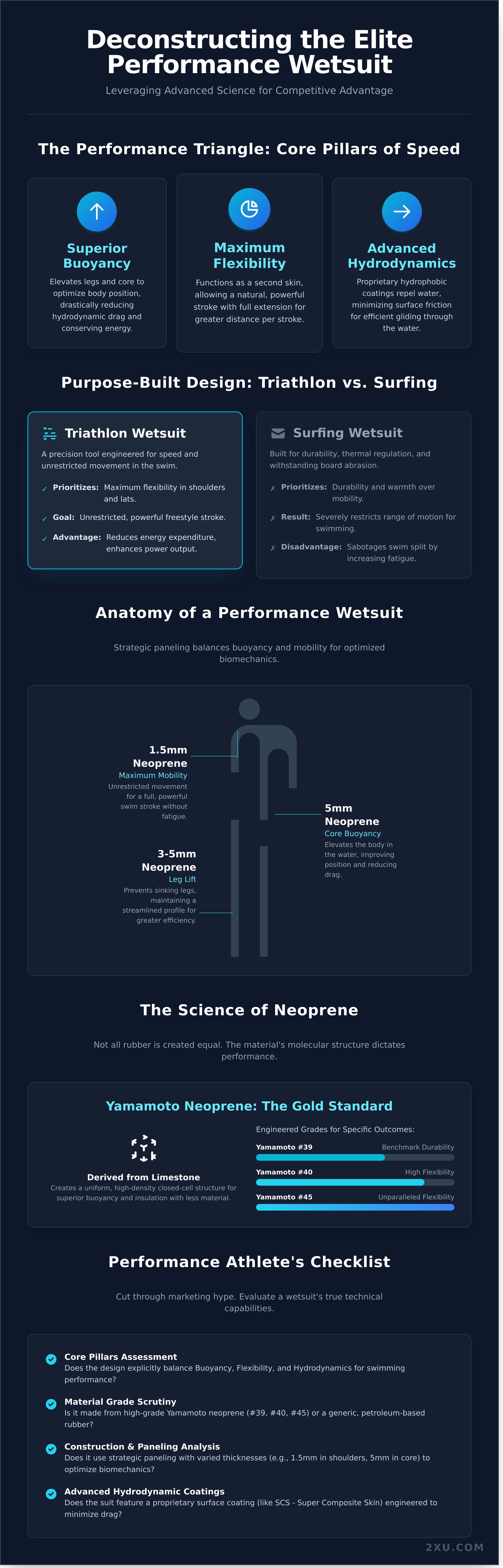
In the pursuit of peak performance, a wetsuit's value is not defined by its price but by measurable, scientific metrics. Mediocrity is not an option. The architecture of high quality wetsuits is engineered around a core triad of performance principles: superior buoyancy, maximum flexibility, and advanced hydrodynamics. These are not independent features; they form a synergistic system designed for a single purpose: to multiply your power output, reduce fatigue, and deliver unparalleled speed in the water. Understanding this foundation is critical before analyzing any specific technology.
The Critical Difference: Triathlon vs. Surfing Wetsuits
Do not mistake one for the other. A triathlon wetsuit is a precision-engineered tool for swimming, prioritizing maximum flexibility through the shoulders and lats to enable an unrestricted, powerful freestyle stroke. Conversely, a surfing wetsuit is built for durability and thermal regulation, designed to withstand abrasion from the board and long exposure in cold water. Using a surfing suit in a triathlon will severely restrict your range of motion, increasing energy expenditure and sabotaging your swim split. The choice is not preferential; it is tactical.
The Performance Triangle: Buoyancy, Flexibility, and Hydrodynamics
These three pillars dictate a suit's performance potential. While the fundamental science of what a wetsuit is centers on thermal insulation, high-performance suits manipulate physics to provide a competitive advantage. This is achieved through the calculated balance of these core elements:
- Superior Buoyancy: Strategically placed neoprene panels with varying densities elevate the legs and core, optimizing body position in the water. This streamlined profile drastically reduces hydrodynamic drag, conserving invaluable energy for the bike and run.
- Maximum Flexibility: The suit must function as a second skin, not a constraint. Advanced, hyper-flexible neoprene through the arms, shoulders, and back allows for a natural stroke with full extension, translating directly into greater power and distance per stroke.
- Advanced Hydrodynamics: The exterior of the suit is a critical interface. Proprietary surface coatings are engineered to be hydrophobic, repelling water to minimize surface friction and allowing you to glide through the water with greater efficiency.
Mastering these elements is what separates basic neoprene from scientifically validated, high quality wetsuits designed to help you achieve your next breakthrough.
The Science of Neoprene: Not All Rubber is Created Equal
The performance of any wetsuit is dictated by its foundational material: neoprene. This engineered synthetic rubber is the critical component that determines buoyancy, flexibility, and durability. Understanding the science of neoprene reveals that its molecular structure directly impacts hydrodynamic efficiency and thermal regulation. In the pursuit of peak performance, mediocre rubber has no place; only precisely engineered materials are utilized in high quality wetsuits.
Yamamoto Neoprene: The Industry Gold Standard
The pinnacle of neoprene technology is Yamamoto, a material derived from limestone rather than petroleum. This proprietary process creates an exceptionally high-density, uniform closed-cell structure, trapping more nitrogen gas for superior insulation and buoyancy with less material. Different grades are engineered for specific outcomes. Yamamoto #39 is a benchmark for durability and warmth, while #40 and #45 cell are engineered with a higher elongation factor, offering unparalleled flexibility for maximum range of motion. This is the material of choice for elite athletes demanding uncompromising performance.
Strategic Thickness Paneling for Optimized Performance
A superior wetsuit is not a uniform sheath of rubber. It is an anatomically engineered system of strategically placed panels with varying thicknesses. This meticulous design ensures optimized hydrodynamics and biomechanics.
- Core Buoyancy: Thicker panels, typically 3mm to 5mm, are deployed across the torso and legs. This increases core warmth and elevates the body in the water, reducing drag and improving body position for greater power output.
- Maximum Mobility: Conversely, thinner panels, as low as 1.5mm, are utilized in the shoulders, arms, and lats. This construction ensures unrestricted mobility, allowing for a full, powerful swim stroke without resistance or fatigue.
The Role of Internal Liners and Fabrics
The material bonded to the neoprene's interior is as critical as the rubber itself. High quality wetsuits utilize advanced, high-stretch jersey liners that work in concert with the neoprene, preventing any restriction of its flexibility. These technical fabrics are engineered not just for comfort and to eliminate chafing, but to enhance the suit's overall durability. Furthermore, many elite liners possess hydrophobic properties, repelling water to ensure a faster drying time-a critical factor for athletes with demanding training and competition schedules.
Engineering for Speed: Hydrodynamics and Surface Technology
In elite swimming, victory is measured in fractions of a second. The difference between a personal best and a missed podium is not chance; it is engineered. Advanced high quality wetsuits are not merely for buoyancy and warmth-they are scientifically designed tools built to slice through water with maximum efficiency. Every surface, coating, and panel is meticulously engineered to reduce friction, conserve energy, and multiply your power output, transforming your raw effort into pure, unadulterated speed.
SCS (Super Composite Skin) Coatings Explained
At the forefront of hydrodynamic technology is the Super Composite Skin (SCS) coating. This is a proprietary layer applied to the external neoprene surface, engineered to create an exceptionally low-friction, hydrophobic barrier. By repelling water at a molecular level, SCS dramatically reduces the surface drag that holds you back. The result is a faster, more effortless glide through the water. This advanced coating is also highly durable and allows the suit to slide off with zero resistance, shaving critical seconds off your T1 transition.
Forearm Catch Panels and Propulsion Zones
While reducing drag is essential, superior wetsuit design also focuses on maximizing propulsion. This is achieved through strategically engineered forearm catch panels. These textured or grooved zones are designed to increase the surface area and 'grip' on the water during the most critical phase of your stroke-the pull. By creating greater resistance against your forearm, these panels allow you to anchor and pull more water with every stroke. This effectively transforms your suit from a passive shell into an active propulsive tool, directly increasing your power output and forward momentum.
The Importance of a Low-Profile, Sealed Collar
A seemingly minor detail with major performance implications is the collar design. A poorly designed collar allows water to scoop in, creating significant drag, adding weight, and compromising core temperature. The most technically advanced high quality wetsuits feature a low-profile, laser-cut collar with a seamless, sealed edge. This eliminates chafing and ensures a watertight fit without restricting movement or breathing. A perfect seal is a critical performance metric, a fact supported by detailed research on wetsuit properties that analyzes seal strength and its impact on overall efficiency. It is a non-negotiable feature that keeps you focused, comfortable, and hydrodynamically sound.
Construction & Fit: The Blueprint for Unrestricted Movement
Proprietary neoprene and advanced coatings are foundational, but their potential is only unlocked through meticulous assembly. Even the most buoyant, flexible material is rendered ineffective by poor construction. The engineering of a wetsuit-how each panel is cut, joined, and fastened-is what separates a performance-multiplying tool from a simple layer of rubber. This is the architectural DNA of high quality wetsuits.
An elite wetsuit must function as a second skin, and that begins with a perfect fit. Without it, every other technological advantage is compromised. A suit that is too loose will scoop water, creating catastrophic drag and weighing you down. A suit that is too tight restricts breathing and circulation, directly inhibiting power output and causing premature fatigue. Fit is not a feature; it is the single most critical factor in wetsuit performance.
Seam Construction: Glued & Blind-Stitched (GBS)
The industry standard for performance is the Glued & Blind-Stitched (GBS) seam. First, the neoprene panel edges are glued together, creating an initial waterproof bond. Then, a specialized sewing machine stitches the seam, but the needle only penetrates one side of the neoprene, never fully puncturing it. The result is a completely watertight, incredibly strong, and low-profile seam that moves with the body and eliminates chafing. This is a non-negotiable element for any serious athlete, starkly contrasting with the bulky, water-permeable flatlock seams found on recreational suits.
The Art of Paneling: Maximizing Range of Motion
A wetsuit is not a single piece of fabric; it is an engineered composite of anatomically-designed panels. The strategic layout of these panels dictates the suit's flexibility. We engineer our suits with fewer seams and larger, continuous panels of high-stretch neoprene through the shoulders, lats, and underarms. This purposeful design minimizes restriction and maximizes reach, allowing for a more powerful and efficient swim stroke. Think of it as a tailored suit versus one off-the-rack-one is built for your body's specific biomechanics, the other is a generic approximation.
Zippers and Rapid Transitions
Every second counts, from the starting horn to T1. That's why high quality wetsuits utilize a reverse zipper, which zips from the bottom up to close. This design is critical in a race environment, as it prevents the zipper from being accidentally pulled down during a crowded swim. More importantly, it is engineered for speed. A single, decisive pull on the lanyard opens the suit from top to bottom, allowing for the fastest possible exit as you run into transition. It is a small detail with a massive impact on your final time.
Evaluating Quality: A Performance Athlete's Checklist
Theoretical knowledge is useless without practical application. To distinguish truly high quality wetsuits from those with superficial marketing, you must conduct a physical, hands-on evaluation. This checklist is your protocol for assessing the engineering, materials, and construction of a suit, ensuring your equipment is a performance asset, not a liability. Execute this assessment with precision.
Material and Surface Inspection
Your initial assessment begins with the suit's core components. Look beyond the logos and analyze the raw materials. A superior suit’s quality is immediately evident through touch and specification analysis.
- Neoprene Grade: The product description must specify the use of premium, limestone-based neoprene, such as Yamamoto #39 and #40 cell, known for its superior flexibility and buoyancy.
- Hydrodynamic Coating: Feel the exterior surface. An advanced SCS (Super Composite Skin) coating will be exceptionally smooth and slick, engineered to minimize surface drag in the water.
- Panel Thickness: Verify the use of varied panel thicknesses. Technical specifications should detail thicker panels (e.g., 5mm) in the torso and legs for buoyancy, and thinner panels (e.g., 1.5-2mm) in the shoulders and arms for maximum mobility.
Construction and Seam Analysis
The assembly of the wetsuit is as critical as its materials. Meticulous construction dictates durability, comfort, and water resistance, directly impacting your performance and energy conservation.
- Seam Integrity: Identify Glued & Blind-Stitched (GBS) seams. These are non-penetrating stitches that minimize water entry and chafing. Inferior flatlock stitching is unacceptable for a performance suit.
- Anatomical Paneling: Examine the panel layout, particularly around the shoulders and lats. Look for large, continuous panels designed to facilitate an unrestricted range of motion during the swim stroke.
- Zipper Function: Test the zipper. It must glide smoothly without catching and feature a secure closure system at the neck to prevent accidental unzipping during competition.
The Non-Negotiable Fit Test
Even the most technologically advanced suit is ineffective if the fit is compromised. This is the final and most critical stage of your evaluation. The suit must feel like a second skin, with zero air gaps or loose areas, especially around the neck, cuffs, and lower back where water can enter. Simulate your swimming motion. Raise your arms and rotate your shoulders. Any feeling of significant restriction or pinching indicates an improper fit or poor design, which will impede your power output and lead to premature fatigue.
Mediocrity in fit guarantees mediocre performance. A perfect fit is paramount. Explore the 2XU wetsuit range for an engineered fit.
Your Performance Edge, Scientifically Validated
The anatomy of a world-class wetsuit is a complex equation of precision engineering. As we've deconstructed, true performance is not a single feature-it is the calculated sum of advanced material science, hydrodynamic superiority, and a fit that amplifies human biomechanics. The difference between a standard suit and the world’s most advanced high quality wetsuits lies in this meticulous, scientific approach, where every millimeter of neoprene and every seam is engineered for a single purpose: to eliminate drag and maximize power.
Mediocrity has no place in your training or on race day. 2XU wetsuits are the tangible result of this core belief, constructed with the world's most flexible premium Yamamoto neoprene for unparalleled buoyancy and thermal efficiency. Our proprietary SCS hydrodynamic coatings are scientifically engineered to slice through water with minimal resistance, while intelligent anatomical paneling delivers maximum flexibility and explosive power output with every stroke. This is not just apparel; it is proven performance equipment designed to shatter your limits.
Shop Scientifically Engineered Wetsuits. Multiply Your Performance.
Frequently Asked Questions
How much should I expect to pay for a high-quality triathlon wetsuit?
A high-performance triathlon wetsuit is a critical investment in your race day potential, with prices typically ranging from $600 to over $1,200. This cost reflects the use of advanced, proprietary materials, including premium Yamamoto neoprene and hydrodynamic SCS coatings. The price is a direct function of the suit's engineered ability to reduce drag, optimize buoyancy, and maximize your power output in the water, providing a quantifiable return on investment through faster swim splits.
Will a more expensive, high-quality wetsuit actually make me faster?
Unequivocally, yes. A high-quality wetsuit is engineered to decrease your swim time. This is achieved through a strategically mapped buoyancy profile that lifts the legs and core, creating an optimal plane in the water to reduce hydrodynamic drag. Furthermore, the use of hyper-flexible neoprene in the shoulder and lat panels ensures an unrestricted range of motion. This allows for maximum power output and stroke efficiency, translating directly into increased velocity and improved performance.
How do I properly care for a high-end wetsuit to ensure its longevity?
Protect your performance equipment to ensure its operational longevity. Immediately after every use, rinse your wetsuit thoroughly inside and out with cold, fresh water. Never use chemical detergents. To dry, hang it inside-out, folded over a wide, smooth hanger at the waist, away from direct sunlight or heat sources. Proper care is non-negotiable; it preserves the neoprene's cellular integrity and the effectiveness of its advanced hydrodynamic coatings, ensuring it performs as engineered.
Can you use a high-quality triathlon wetsuit for surfing or other water sports?
No. A triathlon wetsuit is a piece of precision-engineered equipment designed exclusively for swimming. Its construction prioritizes flexibility and minimal hydrodynamic drag, utilizing delicate, high-stretch neoprene and external coatings. Surfing wetsuits are built for durability and abrasion resistance. Using a triathlon suit for surfing will rapidly degrade its performance materials and will void the manufacturer's warranty. Use the correct tool to achieve optimal results and protect your investment.
What are the key differences between men's and women's high-quality wetsuits?
The differences extend far beyond a simple anatomical cut. Men's and women's high-quality wetsuits feature distinct, gender-specific paneling and buoyancy profiles based on biomechanical data. Women's suits typically incorporate increased buoyancy in the hips and legs to accommodate a different center of gravity. This meticulous engineering ensures optimal body position, efficiency, and power transfer for each athlete's unique physiology, maximizing performance output for both men and women.
Why is Yamamoto neoprene considered the best for performance wetsuits?
Yamamoto neoprene sets the industry standard for high quality wetsuits due to its superior material science. Derived from limestone, its cell structure is over 99.7% water impermeable-significantly higher than petroleum-based alternatives. This results in a material that is lighter, more buoyant, and offers superior thermal insulation. Its molecular composition provides unparalleled flexibility and memory, allowing for maximum athletic range of motion and a second-skin fit that minimizes water ingress and drag.